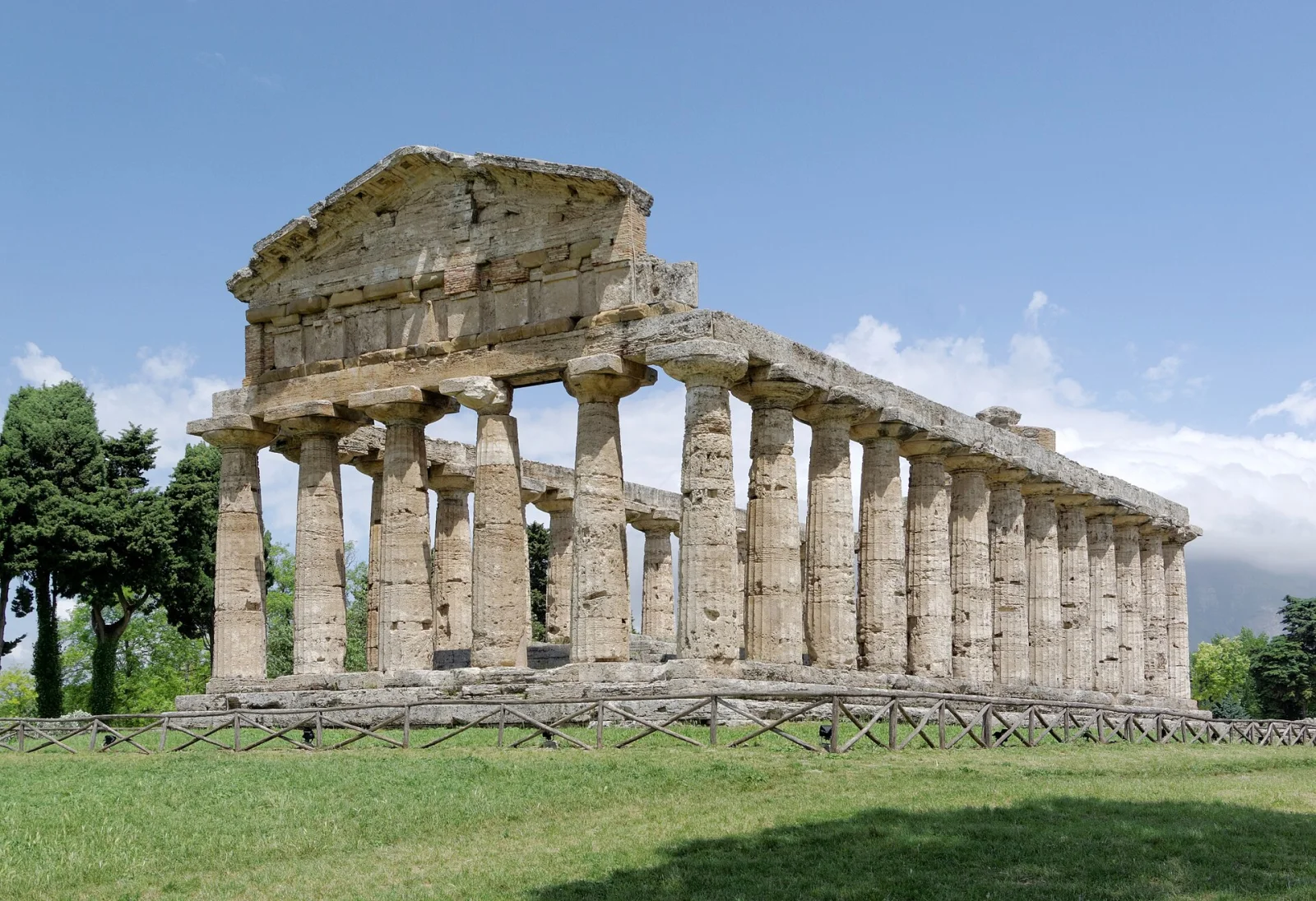
It is the smallest and the most refined of the three temples of Paestum, built around 500 before Christ in the northern sanctuary, at the opposite end from the other two. For centuries it was called the temple of Ceres, then scholarship attributed it to Athena; in the middle ages it was used as a Christian church, and that too is why it has survived so well.
What to see
It rests on an artificial rise in the ground, over an earlier sanctuary probably destroyed by fire. On the front it has the pediment and the Doric frieze with metopes set into the sandstone, on columns slightly more slender than those of the other temples. Inside were the pronaos and the cella, but no adyton, the treasury room at the back.
The proportions are its finest quality: six columns on the short sides and thirteen on the long ones, all equal in size and form, following a scheme that was then a novelty. In the cella three Christian burials were also found, evidence of the building's medieval use.
Visiting
The temple is in the northern part of the archaeological area of Paestum, ten minutes on foot from the other two temples; you go in with the park ticket, which also covers the museum. Half an hour.
Our editors' tip
Look at the sandstone and try to imagine it painted: these temples were covered in bright colours, red, blue, gold, above all on the metopes and the entablature. The white and ochre we admire are the result of twenty-five centuries of rain, and the taste for bare stone is ours, not theirs.