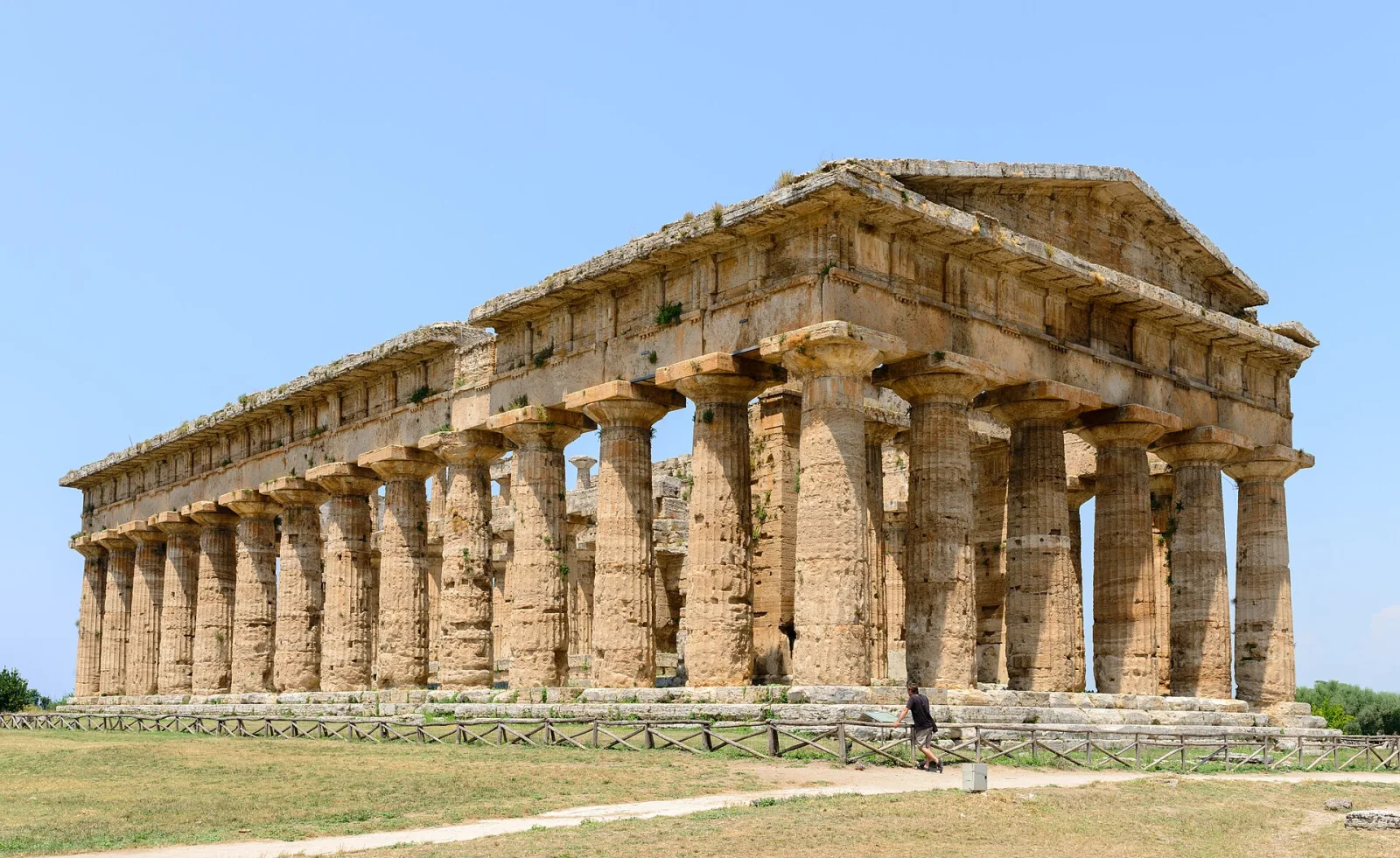
Of all the Greek temples still standing in the world, this is one of the most complete: the columns are there, the entablature, both pediments. Only the roof is missing. It was built around the middle of the fifth century before Christ, at the best moment of Doric architecture, and the name we give it is wrong: eighteenth-century travellers called it Neptune's, but scholars think it was dedicated to Hera or to Apollo.
What to see
The columns are thick and close together, with the swelling at mid-height that corrects the optical effect: seen from a distance they look straight precisely because they are not. Inside the cella there are two rows of columns in two superimposed orders, that is smaller columns above the large ones, which held the roof without needing over-long beams.
The stone is local limestone, porous and honey-coloured, and it changes with the light: white at midday, golden at sunset. Beside it stand the other two temples of Paestum, the basilica and the one of Athena, and you see all three by crossing the site on foot.
Visiting
The temple is in the archaeological area of Paestum, on the sacred way; the visit is covered by the ticket that also serves for the museum. Half a day for the whole site, half an hour for the temple.
Our editors' tip
Walk right round it close to the columns, then move a hundred paces away and look at it three-quarters on: from a distance you see the proportion, from close up the flutes cut by hand and the marks of the tools. They are two different buildings depending on the distance, and both are worth seeing.