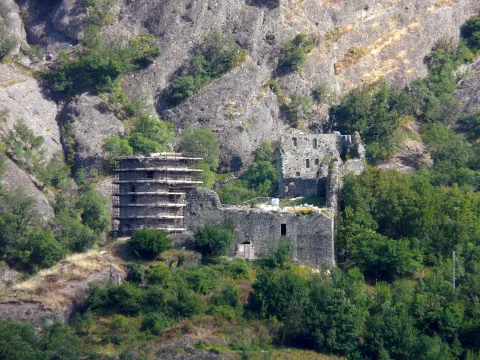
Forty days of shelling and more than 10,000 cannon rounds failed to break it: in the spring of 1547 the army of the Republic of Genoa stalled in front of the castle of Montoggio, where Gerolamo Fieschi had shut himself in after his brother Gianluigi's conspiracy collapsed. Surrender was followed by demolition with explosives, ordered so that nothing of the stronghold would survive. It worked: of the castle that guarded the upper Scrivia valley only rubble under vegetation is left, on a hill a short way from the village centre.
What to see
What you reach at the top is a platform of debris, not standing walls. The plan, though, is well known from period drawings and archive records: the entrance lay to the west, inside a separate square fortification, and a gate tower opened onto a rectangular courtyard about 70 metres long and 25 wide, closed by two thick crenellated walls full of loopholes. To the south the defence was a sheer drop, to the north the steep flank of the hill. Beyond a deep ditch, eastwards, began the lords' quarters: a square block roughly 40 metres a side with four round towers at the corners and, in the middle, the circular keep that held the family residence.
Those towers are the most telling thing the ruin has to say. Around the middle of the sixteenth century the castle was rebuilt to withstand firearms, following what Genoa was testing with the fortresses of Castelletto and Briglia: this is the tower turning into a bastion, though not yet the triangular bastion that Giovanni Maria Olgiati would build in the Mura delle Cappuccine. In their lower forms they echo the surviving tower of the nearby castle of Savignone.
Visiting
The site is an open ruin above Montoggio, with no ticket office and no opening hours: you walk up from the village and pick your way among remains buried in brambles and trees. Closed shoes and a dry day help, because the ground is uneven and the wood has taken back almost everything. What you carry home is not the architecture but the position: from up there it is clear why the Fieschi chose this ridge to hold the valley road.
Our editors' tip
Go and find the spot the castle was shelled from. In March 1547 Olgiati, sent from Genoa with Antonio Doria and 200 infantrymen, picked the best artillery position on Costa Rotta above Granara, about 1,000 metres from the castle and at the same altitude. Looking at the ruins from up there rather than from below explains the siege better than any information board: Agostino Spinola ended up fielding 2,000 armed men, refused to buy the surrender for 50,000 gold scudi, and had to have Ferrante Gonzaga send him another 400 arquebusiers before hunger did the job.