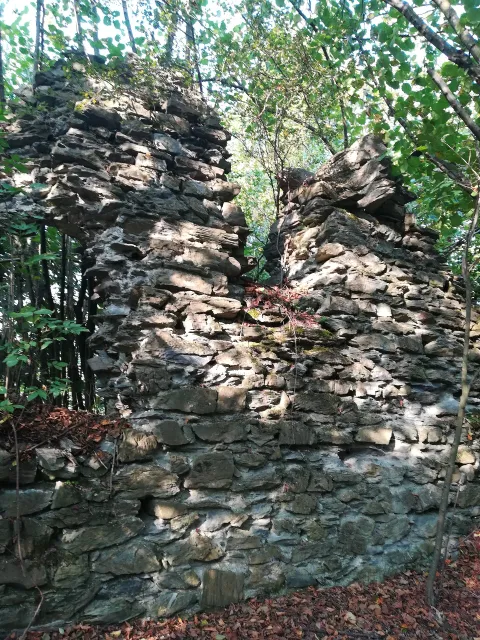
Savignone Castle has neither roofs nor rooms left: what survives is a walled enclosure on a crag of puddingstone, the Savignone conglomerate, the rock that gave the place its name, 150 metres above the village, in the upper Scrivia valley. It is usually dated to 1207, when the men of Tortona founded it and installed a certain Ogerio as castellan, in office until 1210; older documents, a bull of Adrian IV and Frederick Barbarossa's Privilegium, suggest that something already stood here.
What to see
The finest piece is the tower on the south side, horseshoe in plan: straight towards the inside, curved towards the outside, heavy, designed to take the impact of the first firearms. A large window opens on its upper floor and a gun port at the level of the cellars; inside, a stretch of stair survives, along with the hollows of fireplaces on the first and second floors. The same idea had been applied to the four towers of the nearby castle of Montoggio, rebuilt by Sinibaldo Fieschi, and before that to the Genoese fortresses of the Briglia and the Castelletto.
On the other side nothing was needed: the cliff did the defending. At the centre of the enclosure lies the courtyard, the open square where the garrison mustered, reached by a cramped stair coming up from the cellars. Those are cut into the puddingstone: a long room for the soldiers, closed on two sides by the perimeter wall, and a cistern for water. To the north stand the remains of the lord's house, its windows set very high up.
Visiting
The castle belongs to the municipality and can be visited; you reach it on foot from the village, uphill all the way. The ruins have been protected since 1910, when a ministerial note placed a constraint on the marquises Crosa di Vergagni, the last private owners and heirs of the Fieschi. Consolidation work between 2007 and 2013, paid for with European regional funds, secured the barrel-vaulted entrance, the courtyard and the tower; since 2015 the site has hosted historical events and an educational trail set up by the naturalist Ugo De Cresi with the Zampe libere group.
Our editors' tip
We suggest climbing up with one date in mind: 1256, when Giacomo Fieschi, count of Lavagna, signed a contract with the builder Runfredo de Sena for works on the castle. The Fieschi held it longer than any other house, after the podestà of Genoa Corrado di Concesso had wrested the fortress from Guglielmo Spinola in 1242, Spinola having gone over to Frederick II. From up there the stubbornness makes sense: the road to the Oltregiogo and the imperial fiefs ran through here, and whoever held the crag held the passage.