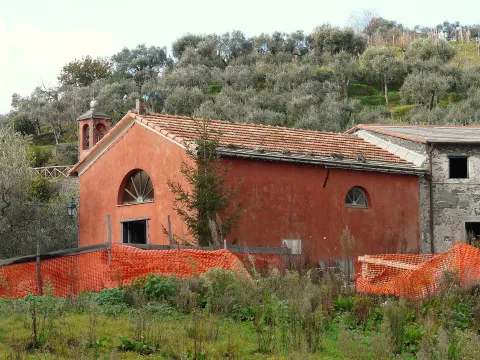
On the evening of the battle of Pavia, 24 February 1525, Francis I of France wrote to his mother Louise of Savoy the line that made him proverbial: all is lost, save honour. Defeated and held prisoner by Charles V, waiting to sail for Spain, the king was kept in the small seaward tower of Cervara Abbey. A plaque still records it, and in 2011 restorers brought back another room of that tower-prison.
What to see
The monastery of San Girolamo al Monte di Portofino was built in 1361 by Ottone Lanfranco, a chaplain of Santo Stefano in Genoa; in 1420 it passed to the Benedictines of Monte Cassino and in 1546 it was raised to the rank of abbey, at a time when Saracen raids along the Tigullio made fortifying it advisable. The church has a Latin cross plan and a tilted apse that alludes to the bowed head of Christ. The columns of the three naves look as though they were built of alternating blocks of slate and marble, in the Ligurian manner: in fact they are brick under two-tone plaster. During the restoration a burial came to light, attributed to Guido Scetten, archbishop of Genoa, poet and friend of Petrarch.
Outside, the Benedictines' kitchen garden has become the only monumental Italian garden left in Liguria, and the only one that faces the open sea: two levels, box hedges, topiary cones and a 17th-century marble fountain with a putto. Terraces and pergolas run around it — a wisteria more than a century old, columns covered in star jasmine — together with the garden of simples, where the monks' medicinal herbs have returned, and the garden of the Hesperides with its potted citrus. From here came the polyptych Gerard David painted in 1506 for Vincenzo Sauli: broken up after the Napoleonic suppressions, it is now split between Palazzo Bianco in Genoa, the Metropolitan Museum in New York and the Louvre.
Visiting
Cervara stands on provincial road 227, the coast road from Santa Margherita Ligure to Portofino, in a spot every Genoese knows by heart. A national monument since 1912, the abbey has been privately owned since 1937: it keeps no museum hours, and you get in on a booked guided visit or during concerts and performances. The complex belongs to the Grandi Giardini Italiani network. Expect steps, terraces and gravel, so leave the heels at home.
Our editors' tip
Ask to step out onto the lower level of the garden, the one that juts towards the water: from there you see the Tigullio on one side and the Portofino headland on the other, and you understand why the monks planted box rather than showy flowers. Then have them open the tower.