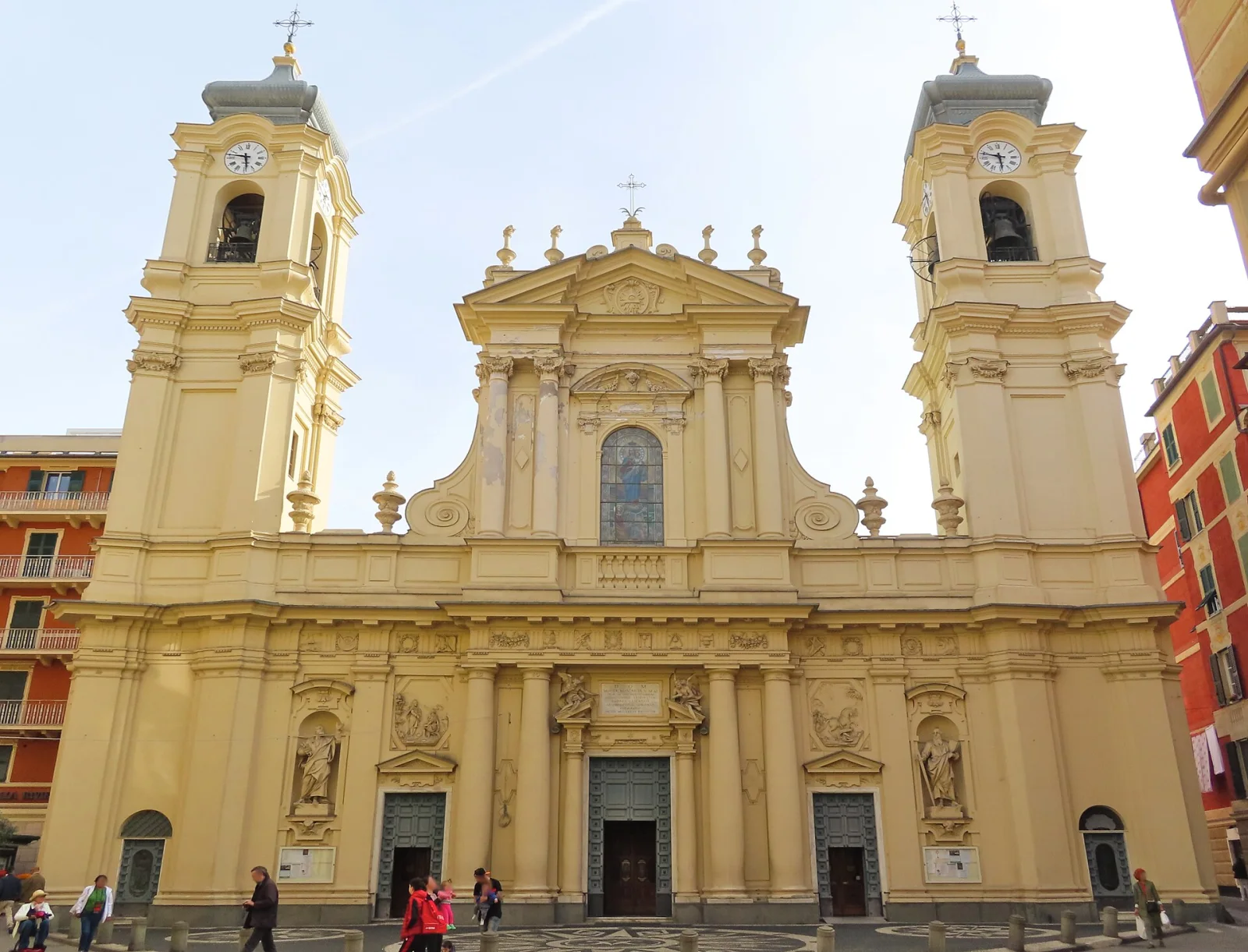
In 1672, as the old church was being pulled down to make room for the new one, a large basin full of water that smelled of roses appeared under the high altar. It is still there, walled up beneath the floor of the presbytery, and the townspeople immediately credited it with miraculous powers. Ever since, the basilica of Santa Margherita Vergine e Martire, on piazza Caprera, has been known to everyone as the sanctuary of Our Lady of the Rose: the Virgin is asked above all for the healing of children, and every year at her May feast the people of Santa Margherita bring roses to be blessed.
What to see
The foundation stone was laid in 1658, on a site where a place of worship already stood in the thirteenth century; the parish, suppressed and absorbed by that of San Siro, had been re-established in 1646 by Cardinal Stefano Durazzo. The Baroque design is by Giovanni Battista Ghiso: a Latin-cross plan, three naves divided by columns, a dome, and the façade turned east, against the old orientation. The solemn consecration took place on 23 September 1770 and is recorded by a marble slab above the main portal; the title of minor basilica came in 1951 from Pius XII.
Inside, the frescoes of the apse and of the presbytery vault are by G. and Luigi Vacca, 1826: the Martyrdom and the Glory of Saint Margaret of Antioch. On the vaults of the nave and the transept Nicolò Cianfranelli painted the Joyful Mysteries in five panels. Among the canvases are the Mystic Marriage of Saint Catherine by Valerio Castello and the Rosary altarpiece by Bernardo Castello, on an altar carved in 1689 by Giacomo Gaggini with columns of Porto Venere marble. The altar of Saint Peter was paid for by the town's fishermen and sailors; in the vestibule of the seaward entrance sits a Roman cinerary urn of the second century, that of Lucius Taiezius Pepso.
Visiting
The basilica stands in the centre of Santa Margherita Ligure, a few minutes on foot from the harbour, and can also be entered from the seaward side. Before stepping through the door it is worth looking down: the forecourt of black and white pebbles is a risseu of 1975, the typical Ligurian paving. The two bell towers are not the same age — the right-hand one dates from 1750, to a design by Carlo Orsolino, the left-hand one from 1920 — and they hold ten bells cast in 1963 by the Picasso foundry of Avegno.
Our editors' tip
Go straight to the marble tabernacle above the high altar: the Virgin holds the Child on her left arm and a rose in her right hand; seafarers brought the figure here in the Middle Ages and documents mention it as early as 1311. It has stood in that place since 25 February 1756 and was crowned on 25 July 1776. Anyone passing through on 20 July will find the procession for Saint Margaret through the old town, with bells and fireworks over the seafront promenade.


