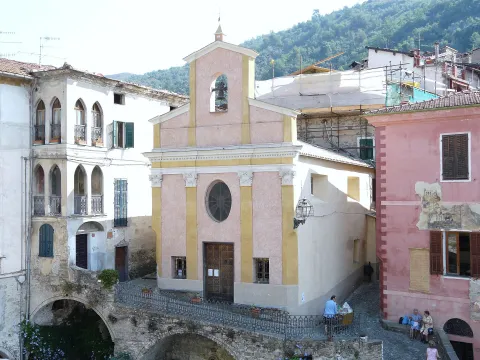
The Hermitage of San Michele is an ancient place of worship in Sanremo, of uncertain early medieval origins, halfway along the road that leads from the Campo Golf to the hamlet of San Romolo. It stands on the ruins of a monastery built by Provençal monks from the abbey of Lérins and dedicated to Saint Michael the Archangel.
What to see
Some parts of the old monastery survive: probably the small church of San Michele, some furnishings, the wooden altars, a few capitals and the refectory. The crypt holds some fine sacred objects, perhaps added by Count Michele Toffetti, who restored the complex around 1855-1860 and made it his last residence. The house, built on the ruins and joined to the small church, looks out over the sea and the valleys of the San Romolo and San Francesco streams.
A legend grew up around the hermitage. In 1849 King Charles Albert had died in exile in Porto, but popular rumour had him hiding in western Liguria; when in 1855 a mysterious gentleman, elegant and of somewhat military manners, landed in Sanremo and withdrew to San Michele, the people of Sanremo thought of him, and the brief evening visits of a stranger were attributed to his son, Victor Emmanuel II. In reality the hermit was Count Toffetti, a Venetian nobleman born in 1796 and descended on his mother's side from the Gonzaga: he had financed the movement for the liberation of Venice, had been banned by the Austrian police, had taken part in the Five Days of Milan and had fled hidden in a barrel to the Capuchin convent of Voltri. The prior, Father De Canis, a native of Sanremo, asked his brother Maurizio, a mason, to buy land far from the town and build the house with the chapel there. The count never left the hermitage again for eleven years: his obituary appeared in the local press on 27 October 1866.
Visiting
According to the sources the exterior can be visited today, while the interior opens only a few times a year, for religious anniversaries or weddings. Dates and arrangements must be checked.
Our editors' tip
Maurizio De Canis, who with his family had shared the count's exile in an outbuilding next to the house, was his sole heir. On De Canis's death the hermitage was donated to the parish of San Giuseppe.