On the left wall of the nave a marble slab dated 1529 shows the Holy Face between Saint Roch and Saint Sebastian: it is signed by Domenico Gar, the sculptor whom the documents call il Franciosino. No other piece tells the story of the church of San Pietro Apostolo better — built in 1474 in Renaissance forms, then turned around by the Baroque works carried out between 1643 and 1683, which even changed its orientation. The building is listed by the FAI.
What to see
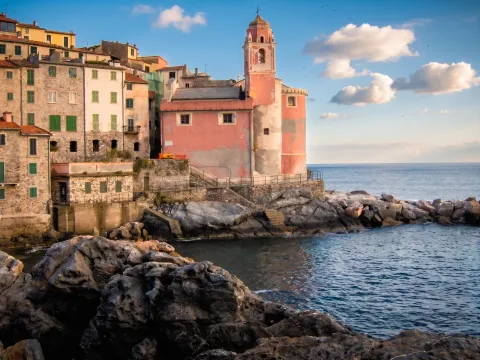
The façade is pink, the same colour as the bell tower beside it, and follows the usual seventeenth-century pattern: two orders divided by pilasters with plain Ionic capitals and festoons. At the centre of the Baroque portal a marble high relief depicts a monstrance; above it, in a niche, stands the statue of Saint Peter, and higher still a quatrefoil window lets the light in. A curved crowning gable flanked by two pinnacles closes the composition.
The wooden door, twentieth century, is dedicated to Mary Mother of the Church and is the work of the sculptor Italo Bernardini. Inside there is a single nave; the chapel opening on the left preserves parts of the fifteenth-century church and the best works: a wooden piece dedicated to the Madonna of the Rosary, opposite it a fifteenth-century triptych recently reassembled and restored, and on the altar a Saint Anthony with the Child from the workshop of Domenico Piola.
Visiting
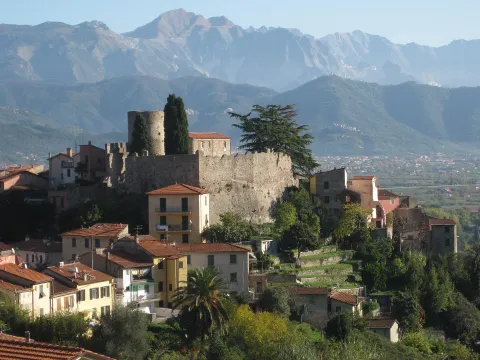
The church is the parish church of Montemarcello, a hamlet of the municipality of Ameglia in the province of La Spezia: the village sits at 266 metres on the Caprione promontory, a few kilometres from the town centre and inside the Montemarcello-Magra regional nature park. You get there on a narrow road climbing from the mouth of the Magra, and you leave the car outside the built-up area, because the layout is that of a fortified village, with narrow, regular lanes. As this is a working parish, opening times follow the services: Sunday morning is the safest moment to find the doors open.
Our editors' tip
Give the 1529 altarpiece a few minutes before anything else: the Holy Face is an unusual subject in this corner of Liguria, and Gar's marble keeps a crisp low relief that only reads properly in the side light of the morning. Then step out to the edge of the village: from the rim of the promontory you can see the Gulf of La Spezia, the Magra valley and the Apuan Alps at once.