Boccaccio's life of Dante contains an episode scholars call improbable and nobody has been willing to drop: the poet, about to leave for France, is said to have handed the manuscript of the Inferno to Friar Ilaro, a monk of Santa Croce del Corvo, asking him to deliver it to Uguccione della Faggiola, while reserving the Purgatorio for Moroello Malaspina and the Paradiso for Frederick of Aragon, king of Sicily. True or not, the monastery today houses the Lunigiana Centre for Dante Studies. It stands on the headland of Santa Croce above Bocca di Magra, where a chapel with a wooden crucifix already existed before the year 1000.
What to see
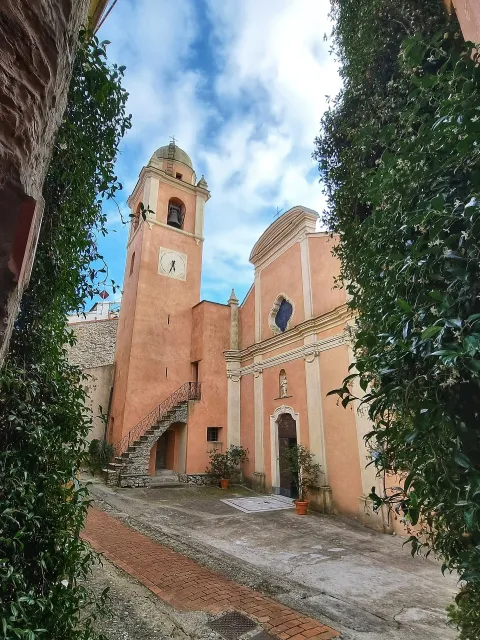
The monastery was founded in 1176 by Pipino Arrighi, bishop of Luni, who on 2 June granted a “monaco de Corvo” 32 giove of land on the promontory. Building went quickly, and in 1186 the complex was entrusted to the Benedictines of San Michele in Pisa. In the fourteenth century everything was abandoned, crucifix included; only in the seventeenth did a restoration that roofed the apse return the church to worship.
The seventeenth-century chapel holds the Santa Croce that gives the place its name: a wooden Christ in Romanesque-Byzantine style, dated between the tenth and twelfth centuries, whose story is tangled with that of the Relic of the Most Precious Blood kept in the co-cathedral of Sarzana. Around the church lie the monumental park and the neo-Gothic castelletto built by the Fabbricotti, marble industrialists who bought the whole estate in the later nineteenth century and made it their home.
Visiting
After the Fabbricotti went bankrupt, around the middle of the twentieth century the property was taken over by Monte dei Paschi di Siena and passed to the Discalced Carmelites of the Ligurian Province, on the initiative of Cardinal Anastasio Alberto Ballestrero; since then it has been a house of retreats and hospitality. It is not a museum, and that is worth remembering: you climb from Bocca di Magra along via Santa Croce, arrive on foot among the pines, and it pays to check the church's opening hours in advance, since they follow the community's day.
Our editors' tip
Go in late afternoon, when the light comes in low down the nave and the crucifix stops looking like a caption. Then step out onto the terrace above the sea: below is the mouth of the Magra, opposite the Apuan Alps white with quarries. It is the same view that someone, in the thirteenth century, thought important enough to put Dante into.