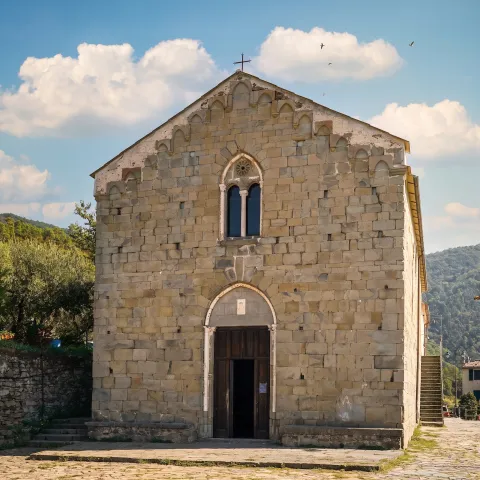
The church of San Benedetto gained its independence with an episcopal bull of 9 September 1569, which released it from the pieve of Marinasco. A century earlier, in 1470, the site already appeared in the records as «Benefitium Sanctis Benedicti»: a chapel was certainly there, but the building took its present shape and size only in the eighteenth century, on top of the rise that lifts immediately behind the Gulf of La Spezia.
What to see
There is little inside, but what there is has quality. The main piece is a Crucifixion on canvas of 1666 by Giovan Battista Casoni; beside it hangs a painting by Carpenino. Less showy and just as interesting are the chasubles and the silk liturgical accessories with polychrome embroidery from the early nineteenth century: the kind of parish outfit that in most places has been scattered or shut away in storage, and that here has stayed where it was.
Around the parish church stands the rest of the hamlet's religious apparatus: the oratory of Nostra Signora del Montale, built in the seventeenth century, and the presbytery, which dates from the nineteen-thirties — the old parish house was then turned into an ordinary dwelling. The church is listed in the Italian catalogue of cultural heritage.
Visiting
San Benedetto is the hamlet that gives the church its name, and it occupies the summit of a rise immediately behind the gulf: the position, more than any architectural detail, is the reason to come up here. The parish belongs to the Bassa Val di Vara vicariate, in the diocese of La Spezia-Sarzana-Brugnato, and its territory gathers a handful of scattered settlements: Montecapri, Montetenero, Pozzo, Debbio, Case Molinari, Porcale Inferiore and Porcale Superiore. Opening follows service times, and outside Sunday Mass the door may be locked.
Our editors' tip
We suggest coming up in the late afternoon and standing on the forecourt before going in: from here the logic of the settlement reads at a glance, the gulf on one side and the scattered hamlets on the other, with the church planted at the point where both are in view. If you find it open, take your time over the Crucifixion: in hamlet parish churches seventeenth-century canvases are almost always left in half-light, and it is worth asking for the lights to be switched on.