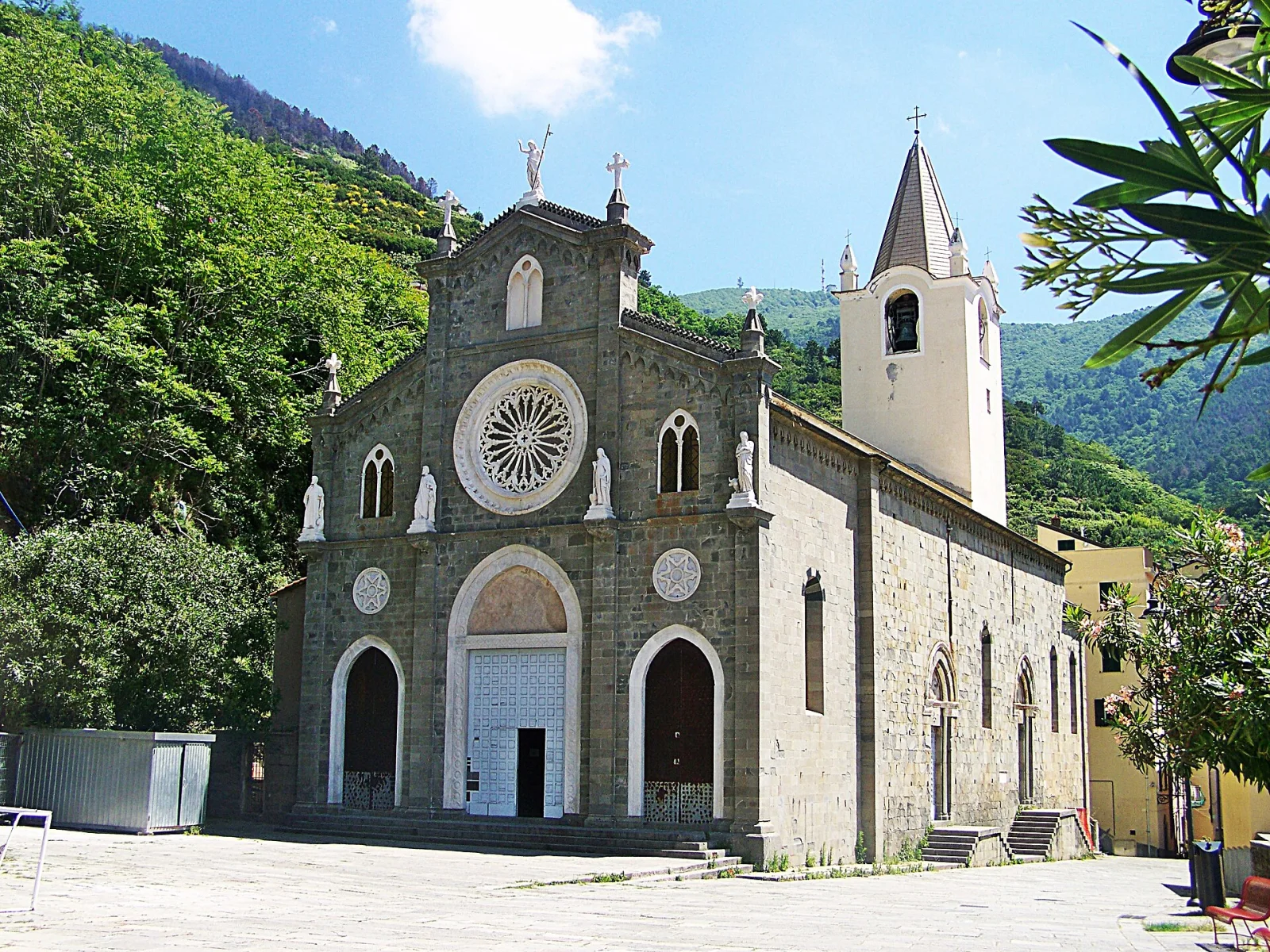
A plaque set into the front wall records when the church went up and at whose wish: 1340, the bishop of Luni, Antonio Fieschi. Since then San Giovanni Battista has been the parish church of Riomaggiore, on via Pecunia, in the upper part of the old town. A collapse forced a heavy rebuilding between 1870 and 1871: the body of the church was lengthened and the front redone in neo-Gothic style, though the fourteenth-century rose window in white Carrara marble was kept in place.
What to see
The right flank is the part that held: it preserves the single-light windows and two Gothic portals, carved with animal and human figures of Romanesque date, so close to the Antelami tradition that they suggest craftsmen trained on that model. Inside, the plan is basilican, three aisles marked out by pointed arches.
The works are concentrated in the right aisle: the Preaching of John the Baptist by Domenico Fiasella of Sarzana, a triptych of the Virgin and Child between Saints Roch and Sebastian attributed to the Master of the Cinque Terre, a wooden Crucifix by Anton Maria Maragliano, and the marble pulpit of 1663, which carries an older high relief, dated 1530, showing Saint Martin and the beggar between Saints Anne and Joachim. The presbytery and the two end chapels, closed off by a balustrade with statues, are late Baroque in feel; behind the high altar, set with two eighteenth-century statues, runs the wooden choir of the same period, while two marble altars stand at the sides, the right one holding a sculpted group of the Madonna and Child. The organ dates from 1851 and was signed by the Agati firm of Pistoia.
Visiting
The church sits above the main street of Riomaggiore: you reach it by climbing the alleys, with a few flights of steps, as almost everywhere in the Cinque Terre. It remains a working building, a parish seat in the Riviera vicariate of the diocese of La Spezia-Sarzana-Brugnato: opening hours follow the services and you may well find a Mass under way. Come when the daylight outside is strong, because the narrow windows give little, and the paintings in the right aisle lose almost everything in shadow.
Our editors' tip
Our advice is to look at the front from outside before going in: the fourteenth-century rose window and the nineteenth-century rebuilding share the same wall, and spotting the join between them is the quickest way to grasp the history of the building. Then step inside and stop at the pulpit, where the relief is older than the structure carrying it, a reuse declared without ceremony. If you still have time, walk round the outside on the right, where the Gothic portals are the most intact thing left from the fourteenth century.