The Mulino Vecchio stands along the Roggia Molinara, inside the natural park of the Ticino valley, and is still working. Its construction falls between 1484, when the digging of the canal began, and 1545, when it appears in an inventory of the property of Ippolito del Mayno, a feudatory tied to the Sforza. Later the mill was bought back by the community of Bellinzago and rebuilt from top to bottom in 1718: the date is carved on the outer wall facing the water.
What to see
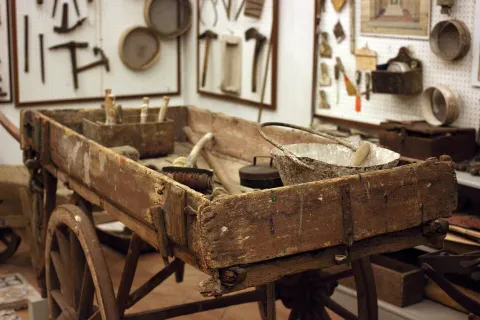
The complex consists of the mill building with stable, portico and pigsty, and of a dwelling with keep and courtyard. On the ground floor is the millstone room, machinery still in place: a wooden mezzanine holding three pairs of stones, protected by a circular casing, with the feeding hopper above; below, the containers that gather the flour. On the hopper sits an alarm worth the visit on its own: a small bell and a wooden bird-shaped piece that signal when the grain runs out. Beside it is a room with the kitchen and the bread oven. On the first floor a permanent display gathers documents and objects of farming and milling work.
Visiting
Outside, on the canal, three iron water wheels turn, each in its own stone channel; alongside runs a fourth small channel, the spazéra, used to regulate the water level and outflow. The stable now hosts teaching workshops, temporary exhibitions and screenings: the mill passed to the park consortium in 1985 and became a regional centre for environmental education.
Our editors' tip
The ownership record tells the town's story better than many chronicles: confiscated by the Napoleonic state between 1813 and 1814, sold to private owners, bought in 1925 by the Ambrosetti, millers of Bellinzago, who enlarged it, and finally handed to the park. Anyone bringing children should ask to have the wheels turned: the noise of water and stone explains the trade in thirty seconds.