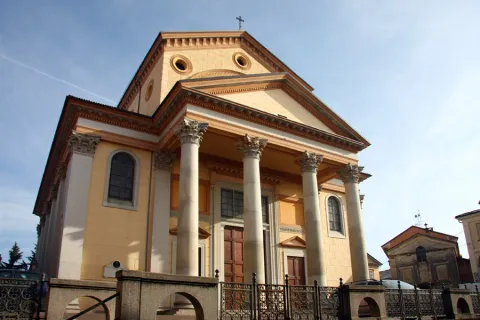
The sanctuary stands at Loreto, a hamlet northeast of Oleggio, and the design is by Pellegrino Tibaldi. The first document concerning it is dated 20 August 1600 and lists the deputies charged with following the works; the first building phase, according to the visitation of bishop Ferdinando Taverna, ran from 1611 to 1618, though the building had already been started earlier.
What to see
The façade follows the Roman model of the Counter-Reformation, with a double Corinthian order. In the lower niches stand Saint Paul with his sword and Saint Peter with his keys; above the side doors, now walled up, are reliefs of the Annunciation and the Visitation, and in the pediment the Assumption of the Virgin between two putti. The statues, however, came late: the façade was only completed in the 1870s, with works by the local sculptor Giuseppe Argenti.
Visiting
The interior has three naves, with a semicircular apse and an octagonal lantern tower. Flanking the high altar are those of Saint Catherine and Saint Christina, and on the latter a canvas of the Martyrdom of Saint Christina attributed to Morazzone. In front of the sanctuary runs a tree-lined avenue laid out in the late eighteenth century by Stefano Ignazio Melchioni.
Our editors' tip
Part of these rooms had a use you would not expect: before 1890 they served as a lazaretto for infectious patients, and the lazaretto stayed in operation until 1935.