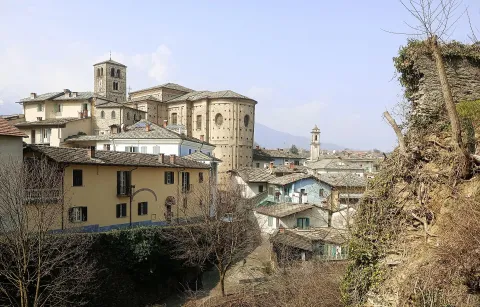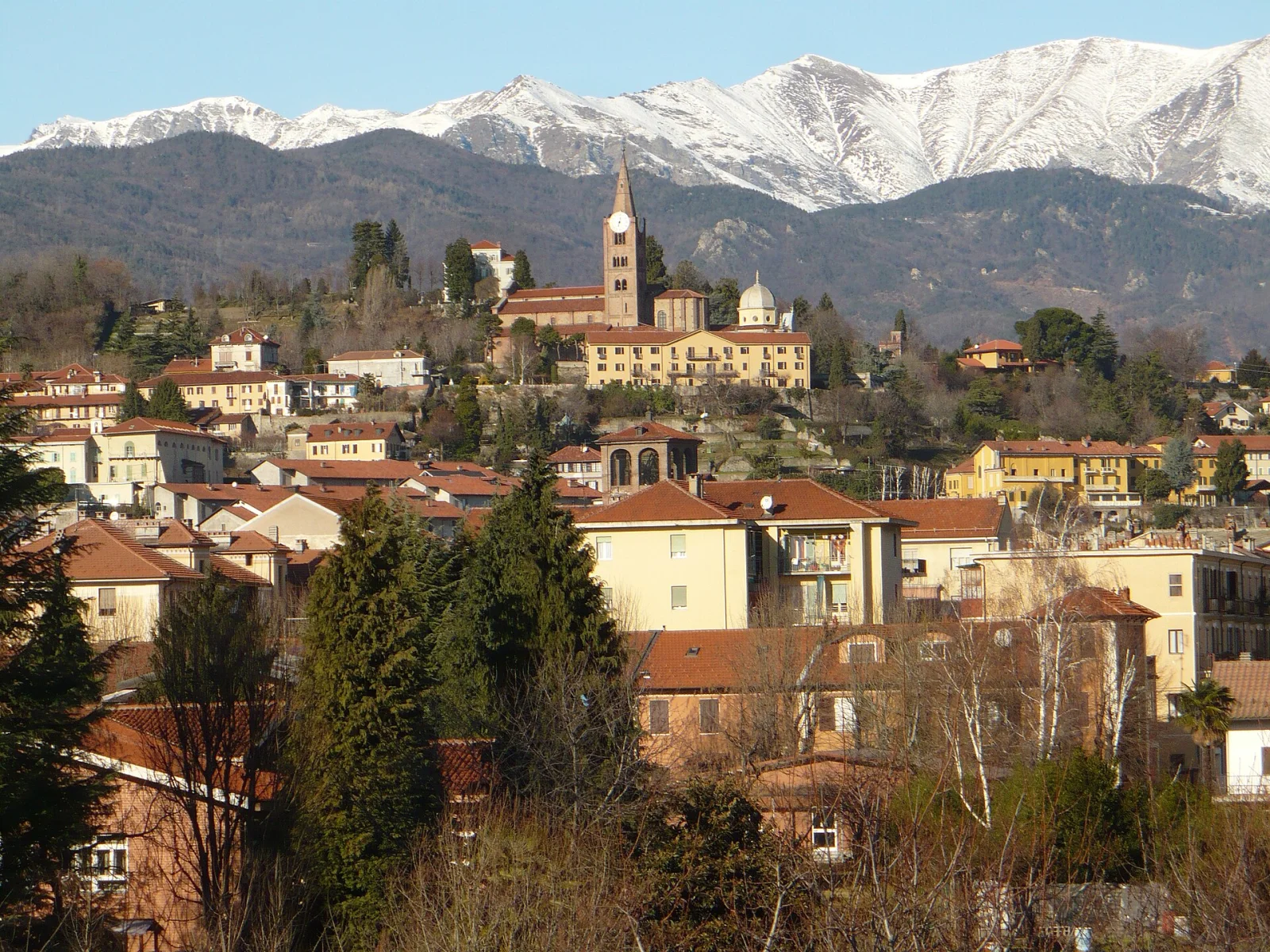
The basilica of San Maurizio stands on the hill of Pinerolo, in what in the Middle Ages was the heart of town life. The oldest document that records it is a charter of 26 October 1078, by which Countess Adelaide makes a donation to the monastery of Santa Maria; according to a well-regarded hypothesis, however, the church would go back to the Lombard age. Too small and in poor condition, from the fifteenth century it was rebuilt in several stages: the works ended only in 1635, after a donation by Duke Carlo Emanuele of Savoy in 1614. In 1665 a lightning strike damaged the church and set fire to a powder magazine: the dead numbered about four hundred, and the bodies were piled up in San Maurizio, which for reasons of public health was closed to worship. In 1748, when the diocese was created, San Donato was chosen as cathedral, and from several quarters came requests to pull San Maurizio down; the church instead went on being used for worship, and in 2002 John Paul II raised it to a minor basilica.
What to see
The façade is in brick, marked by pilaster strips that echo the five aisles of the interior. Beside it rises the fourteenth-century bell tower, which was also the civic tower and the property of the town: an inscription inside it attributes the design to the architect Pietro da Milano. In 1388 the town council resolved to give it a clock and for this taxed all the citizens, except widows and the poor. In 1840 a new clock was fitted, devised by Ignazio Porro of Pinerolo, an artillery officer: four dials driven by a single mechanism.
The interior has five aisles on piers, with cross vaults and a neo-Gothic decoration painted at the end of the nineteenth century. The high altar, all in marble, dates from 1743 and was wanted by the benefactor G. B. Ambrosino. Among the paintings are the Ascension by Giuseppe Antonio Petrini, a Ticino painter from Carona, and the Nativity of the Virgin by Claudio Francesco Beaumont; among the frescoes, a fifteenth-century Lamentation over the Dead Christ and a St Radegund with St Germanus attributed to Jacobino Longo of Pinerolo. Since 1898 the church has held the tomb of the princes of Acaja, whose remains were brought here from the church of San Francesco.
Visiting
From the centre you climb along Via Principi d'Acaja to the square in front of the church. Opening and Mass times should be checked with the parish.
Our editors' tip
Look for the staircase that links the basilica to the sanctuary of the Madonna delle Grazie, the building that partly hides the apses. Along the staircase the ex-votos are kept: pictures painted on cardboard, canvas or cloth and embroideries on silk, giving thanks for recoveries, episodes of war, accidents on the road and at work, dangers met in the fields.