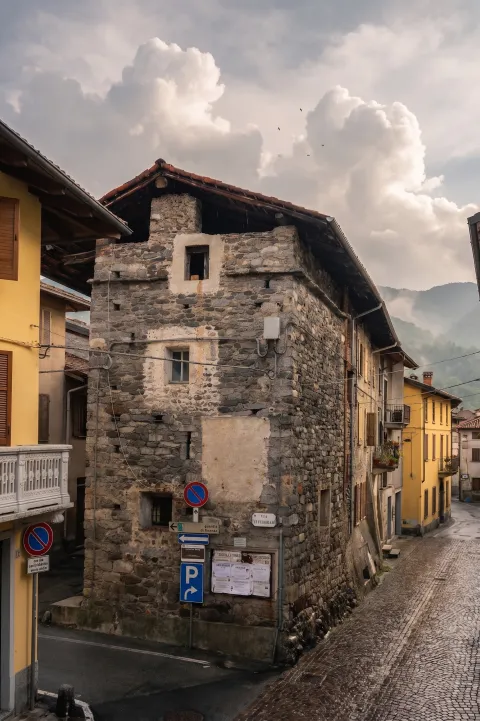
The church stands on via Fratelli Antongini, at one of the key points of the old Borgofranco: the walls ran past here, and here were the rope and the boat used to cross the Sesia. It was already standing when the Borgofranco di Seso was founded in 1247, and it was dedicated to Santa Maria; the name everybody uses came after 1590, with the Confraternity of Saints Bernardino and Marta, later retitled to the Blessed Sacrament. Its story is entangled with that of the Borgognoni, influential landowners who had a hand in founding the town's first hospital.
What to see
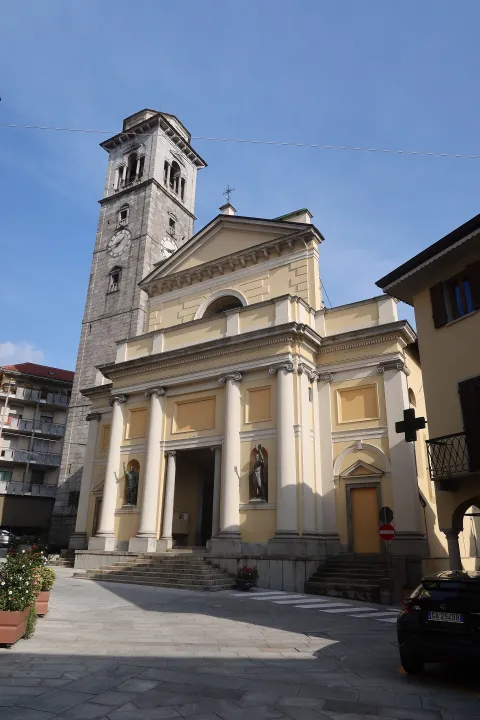
Outside it is plain: a smooth gabled front, small oval and square windows, a three-light opening in the middle of the tympanum and, above the doorway, a fresco of the Virgin of Graces; another fresco in the church shows Saint Anne. The bell tower is of stone, with two-light windows and bracket capitals, and it is the element that best betrays the building's age. Inside, the plan has three naves marked out by two rows of columns and broad arches ending in three apses: what you see is essentially seventeenth-century, with eighteenth-century decoration and nineteenth-century restorations. Antonio Orgiazzi the Elder painted the naves in the eighteenth century with airy, colourful rocaille motifs, and that is the note you remember on the way out. Along the left side run the Stations of the Cross donated in 1709 by the Perdomi family, a seventeenth-century Presentation of Mary at the Temple by an unknown hand, and a fresco of the blessed Panacea. The right apsidal chapel holds a Saint Sebastian portrayed together with members of the confraternity, and the neoclassical chapel of Santa Rita an Assumption of the Virgin with the same brothers posing in it.
Visiting
The furnishings include a symphonic band organ from the second half of the nineteenth century made in the Scolari workshop, the wooden choir loft, railings in wrought and painted iron, and the old banner in painted and embroidered cloth listing the brothers; the sculptures in painted and gilded wood depict Saint Martha and Saint Bernardino. Precious illuminated antiphonaries of the fourteenth century also come from this church and are now kept in the diocesan archives of Novara. It should be said that the building is normally closed: it opens for services and for special openings, and anyone set on seeing it does well to ask at the parish before turning up at the door.
Our editors' tip
If the door is shut, the walk is not wasted: you are in the heart of the medieval Borgofranco, and the parish church of Saints Peter and Paul is a few minutes away. But if you do find it open, look up: Orgiazzi's vaults are the cheerful part of a church whose exterior promises nothing but restraint.