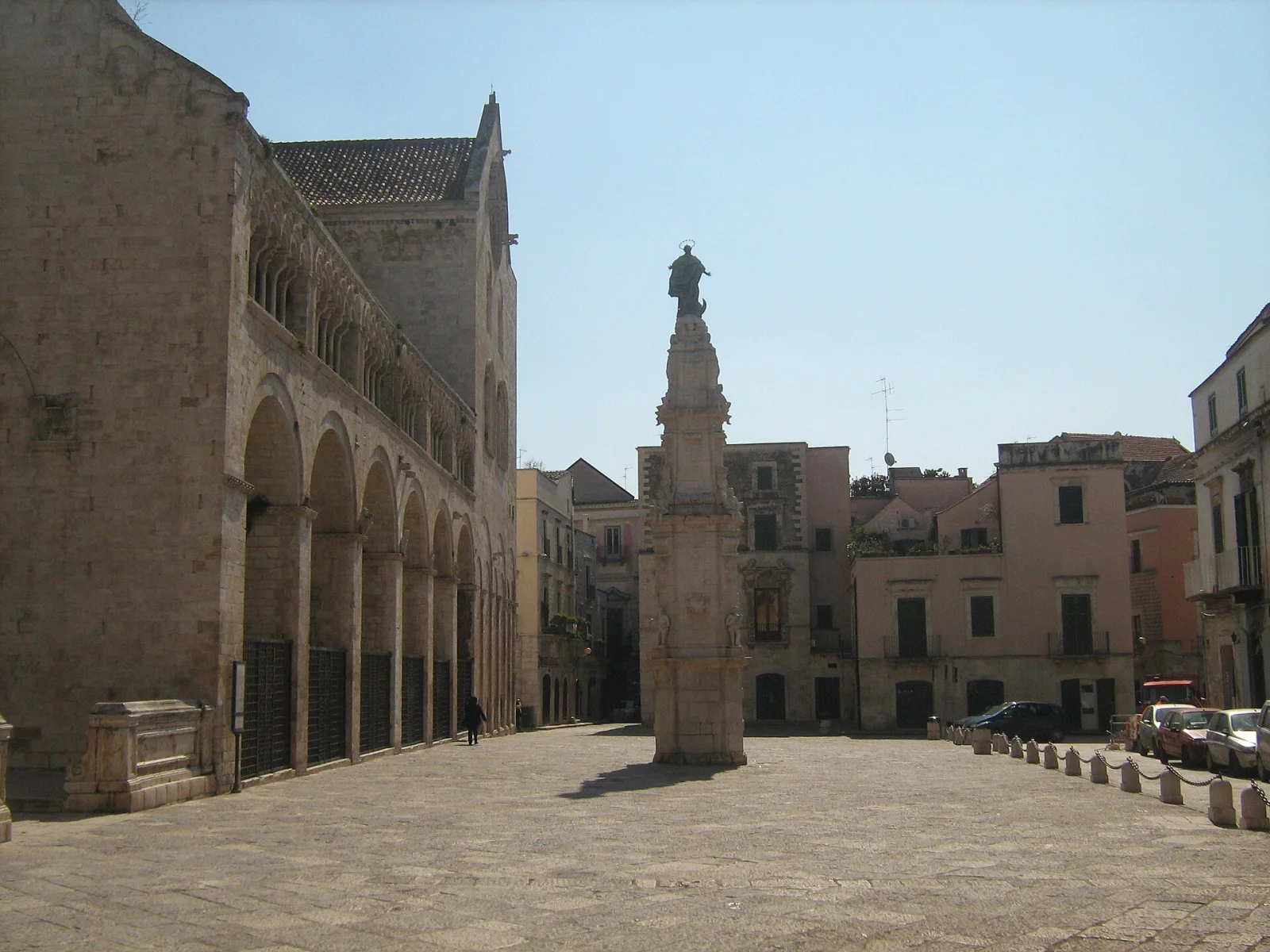
The church of San Francesco d'Assisi, known as della Scarpa, stands at the edge of the town centre of Bitonto, on piazza Minerva, where a Romanesque chapel dedicated to Santa Maria Mater Domini is said to have once stood. The former bishop's seminary attached to the church houses the town's diocesan museum.
What to see
According to tradition the church was raised in memory of the visit, in 1222, of Saint Francis of Assisi with his fellow friar Luke of Bitonto, first provincial of the Franciscans in the Holy Land; it stands on the acropolis of Bitonto and, according to the sources, on the ruins of the Roman temple of Minerva. Construction began in 1283 under the direction of Sergio Bove, with the consent of Charles of Anjou, and the church was consecrated in 1284 by Bishop Leucius, to whom perhaps belongs the tomb slab with the effigy of a bishop, later turned into the lintel of the apse window. It was entrusted to the Franciscans, who at once built a convent: only the fifteenth-century cloister survives, absorbed into the bishop's seminary building. The convent served as a hospital during the battle of Bitonto of 1734 and was closed in 1809 following the decree issued by Joachim Murat; in 1842 the church underwent major works and the original covering of the apse was replaced by a dome, while the restoration of 1993 recovered the paving, the altar and some paintings.
The facade, in late Romanesque style, is the oldest part and also the best preserved; it stands at the top of a flight of steps that highlights its imposing structure. On the left is a large cubic sixteenth-century chapel with a dome set against the facade; on the right the seventeenth-century bell tower, in three sections, ending in a pyramidal onion dome and bearing at its entrance the inscription «SANCTUS IMMORTALIS, SANCTUS DEUS FORTIS, MISERERE NOBIS». The portal, with a pointed arch, has a double archivolt enriched with carvings of leaves and pine cones, and above it are the coats of arms of the Bove family, who built the church; higher up an elegant triple window, set in a large pointed arch of clear French influence (Toulouse Gothic), gives lightness to the massive whole, and a fifteenth-century window has taken the place of the old splayed oculus. In the first chapel on the right frescoes show the Virgin and Child and Saint Francis, and others are coming back to light with the restorations. Inside, the sixteenth-century altars once held works by Gaspar Hovich and Carlo Rosa, now in the bishop's picture gallery; the presbytery keeps late medieval sculptures and the sacristy, of two rooms from the eighteenth century, is furnished with period pieces.
Visiting
The church is on piazza Minerva, at the edge of the town centre, and hosts musical activities. The sources consulted give no opening hours or visiting arrangements: check them.
Our editors' tip
The former bishop's seminary attached to the church houses the Diocesan Museum; of the Franciscan convent only the fifteenth-century cloister remains, absorbed into the seminary building.


