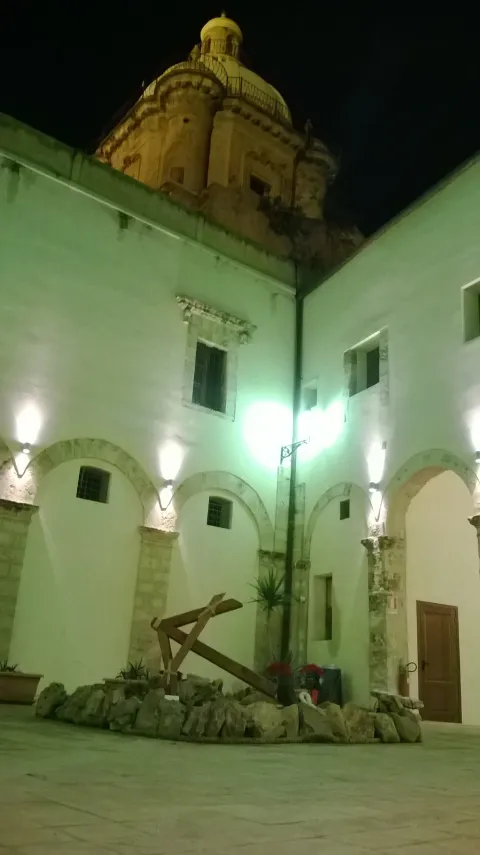
In 1566 the Augustinian friars were granted the church of Santa Maria del Soccorso by Aloisio Suppa, bishop of Agrigento, but its perch near the top of Licata's hill sat too far from town. They settled instead on an older chapel west of the walled city, dedicated to Saint Margaret of Antioch and standing beside the royal grain warehouse. There they built their convent and reversed the building's axis, moving the entrance from west to east. This is the origin of Licata's church of Sant'Agostino, known today as the Sanctuary of the Madonna Addolorata: on 13 April 1973 it was raised to sanctuary status under the title “Maria SS. Addolorata”.
What to see
The façade is the oldest part still standing, sober and classical, crowned by a broken circular pediment whose three central openings double as a bell chamber. The only surviving eighteenth-century features are the two pilasters of dressed stone and the quatrefoil window above them; the rest dates to the early 1800s. Inside, a single nave keeps the same restraint. The main altar is modern. Of the two side altars, the right holds an eighteenth-century oil painting of the Madonna della Cintura with the Child and Saints Augustine and Monica, while the left carries an old, finely carved Crucifix. Two twentieth-century canvases of Augustine of Hippo and Pope Gregory I came from the nearby chapel of San Girolamo. Under the arch that shelters the statue of the Addolorata run seven round paintings of the Virgin's Seven Sorrows, by the Licata painter Giuseppe Spina.
Visiting
The devotional heart is the wooden statue of the Sorrowful Madonna, attributed to one Giuseppe Piccone and carved in the second half of the eighteenth century. Tradition ties it to a sailing ship wrecked in a storm off the harbour: Licata's sailors, coming to the rescue, found the statue aboard and were allowed by the captain to keep it, setting it on the altar of a nearby church. The figure wears a silver halo and a dagger at the breast, and bears a medallion holding relics of the Crucifixion. Little wonder that Sant'Agostino has always been the church of the port workers.
Our editors' tip
Before stepping inside, pause out front to pick out the two stone pilasters and the quatrefoil window: they are the only eighteenth-century fragments to survive the church's many restorations. And if the Augustinian thread interests you, note that the marble Madonna and Child the friars once brought here has left the church, and now stands in Licata's Museo archeologico della Badia.