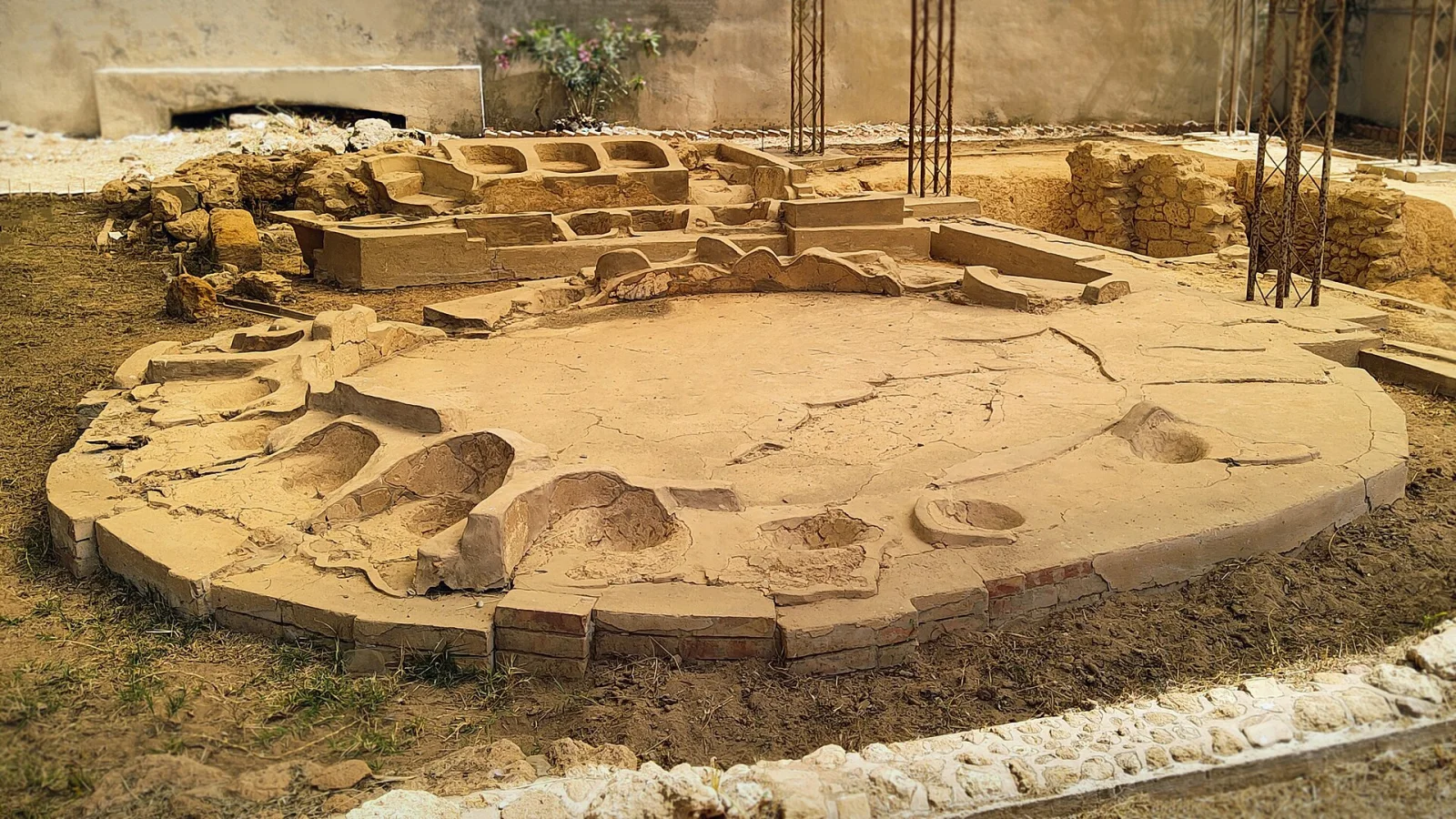
The Greek baths of Gela are a Hellenistic bathing establishment of the fourth century BC, in the Caposoprano district, on via Europa, near the Centro Servizi alla Persona «Antonietta Aldisio». The sources regard it as the oldest example of public baths found so far in Italy; it was destroyed by a great fire in 282 BC, after the conquest of the city by the tyrant Phintias.
What to see
The complex has two rooms, originally separated by a plastered wall of raw clay bricks and covered by a roof of terracotta tiles. The first, to the north-west, has two groups of tubs arranged radially around a central space and linked to a drain. The first group originally counted fourteen Greek-type «seat» tubs, of which twelve remain today, arranged in a horseshoe around a floor of square terracotta slabs: under each there is a hemispherical hollow for resting the feet or for emptying it, since it has no drain holes and had to be emptied by hand. The tubs in the straight rows are of concrete conglomerate covered with white plaster; those of the western stretch are of terracotta and portable, perhaps belonging to an older complex later transformed. The second group, of twenty-two tubs arranged in a circle, lacks its rear half, perhaps because the building work was never finished.
The second room, to the east, has a heating system with a small chamber and two underground corridors where the fuel was burned: the floor of the upper room rested on the walls of the space below, creating a hypocaust that served as a sauna. It is the oldest heating system preserved among the Greek baths found so far. The installation was discovered at the end of February 1957 and dated between the end of the fourth and the start of the third century BC thanks to unguentaria, an oscillum, amphorae and coins of the Timoleontic age found on the floor; the thick layer of earth and ash that covered it allowed its end to be linked to a violent fire, in all likelihood the destruction of Gela by Phintias.
Visiting
The baths are on via Europa, in the Caposoprano district, near the Centro Servizi alla Persona «Antonietta Aldisio». The sources consulted do not say whether the site can be visited or at what hours: it is best to ask the Comune di Gela or the Soprintendenza before going.
Our editors' tip
In 2012 a little further south a second Hellenistic bath complex was found, round, about 4 metres across, with hip-bath tubs arranged in a circle around a floor decorated with a coloured-pebble mosaic of a nereid on a ketos, preserved over a little more than a quarter of its original size. The refined decoration and the sea view suggest a select clientele, while the complex of 1957 would have been used by a more ordinary public.


