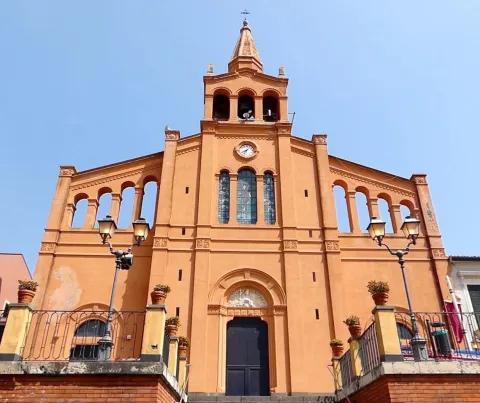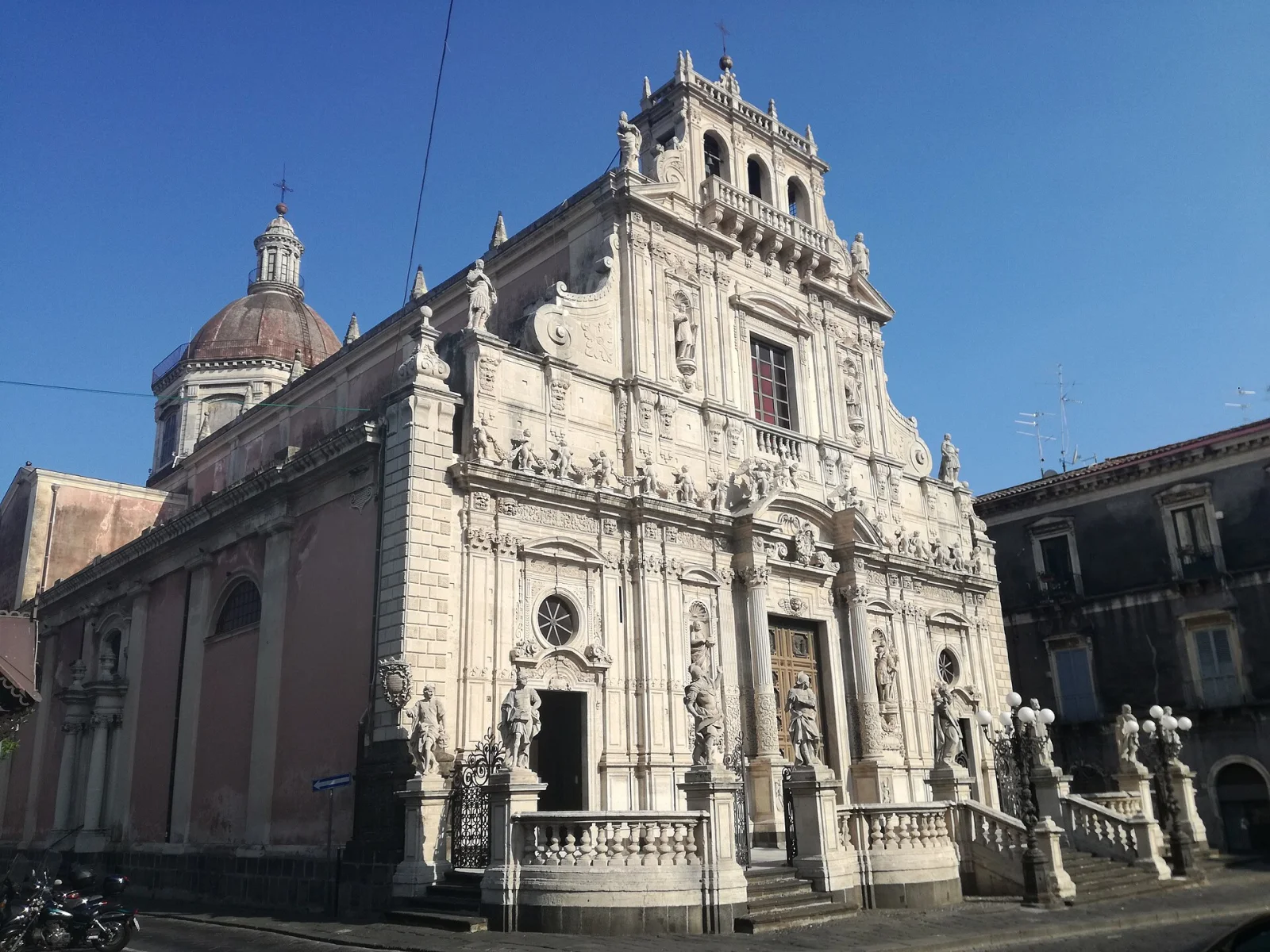
The collegiate basilica of San Sebastiano faces corso Vittorio Emanuele and piazza Lionardo Vigo, in the old town of Acireale. The first church dedicated to the saint, built in the fifteenth century after an outbreak of plague, stood where the church of Sant'Antonio di Padova is today; when the new, large church was ready and Saint Sebastian was proclaimed co-patron of the town, the old buildings passed to Saint Anthony, on 13 July 1652. The earthquake of 1693 brought down the choir, and the church was rebuilt in its present form. It has been a collegiate church since 1924 and a minor basilica since 1990.
What to see
The façade, designed by Angelo Bellofiore, rises in several orders and is full of decoration: a frieze of fourteen putti holding garlands, corbels, masks, pinnacles and volutes. In the niches stand statues of Saint John the Baptist and Saint Christopher beside the portal, Saints Gervasius, Lawrence, Vitus and Protasius on the second order, and Saints Cosmas and Damian on either side of the bell loggia. In front runs the balustrade made in 1754 by Giovan Battista Marini to a design by Pietro Paolo Vasta, with ten statues of Old Testament figures, from David and Moses to Daniel and Samson.
The interior has a Latin-cross plan and three naves. The most important cycle is by Pietro Paolo Vasta: in 1732 he won the contest against the Acireale painter Venerando Costanzo, who painted the Conversion of Chromatius in the right transept, with the Appearance of Christ to Saint Sebastian in the house of Nicostratus, in the left transept, and between 1733 and 1734 he painted the Glory of Saint Sebastian on the vault and the stories of the saint in the choir; in 1745 he returned for the Old Testament episodes under the dome and the four major prophets in the pendentives. The dome has the Ascension by Francesco Mancini Ardizzone, who also painted the scenes in the transept between 1899 and 1901. Around 1960, under layers of whitewash in the nave, fifteen frescoes of the life of the saint came to light, attributed to Costanzo. In the chapel of the Pietà is Vasta's Pietà of 1742 and, in a glass urn, a copy of the Shroud made in 1644.
Visiting
The church is on piazza Lionardo Vigo; the crypt holds a museum section with wooden statues and paintings. Opening hours should be checked with the parish.
Our editors' tip
The statue of Saint Sebastian, kept behind the canvas of the altar in the right transept, comes out on 20 January on the silver float pulled by the «divoti», the devotees: the float was designed by Vasta in 1756 and only completed in the nineteenth century.