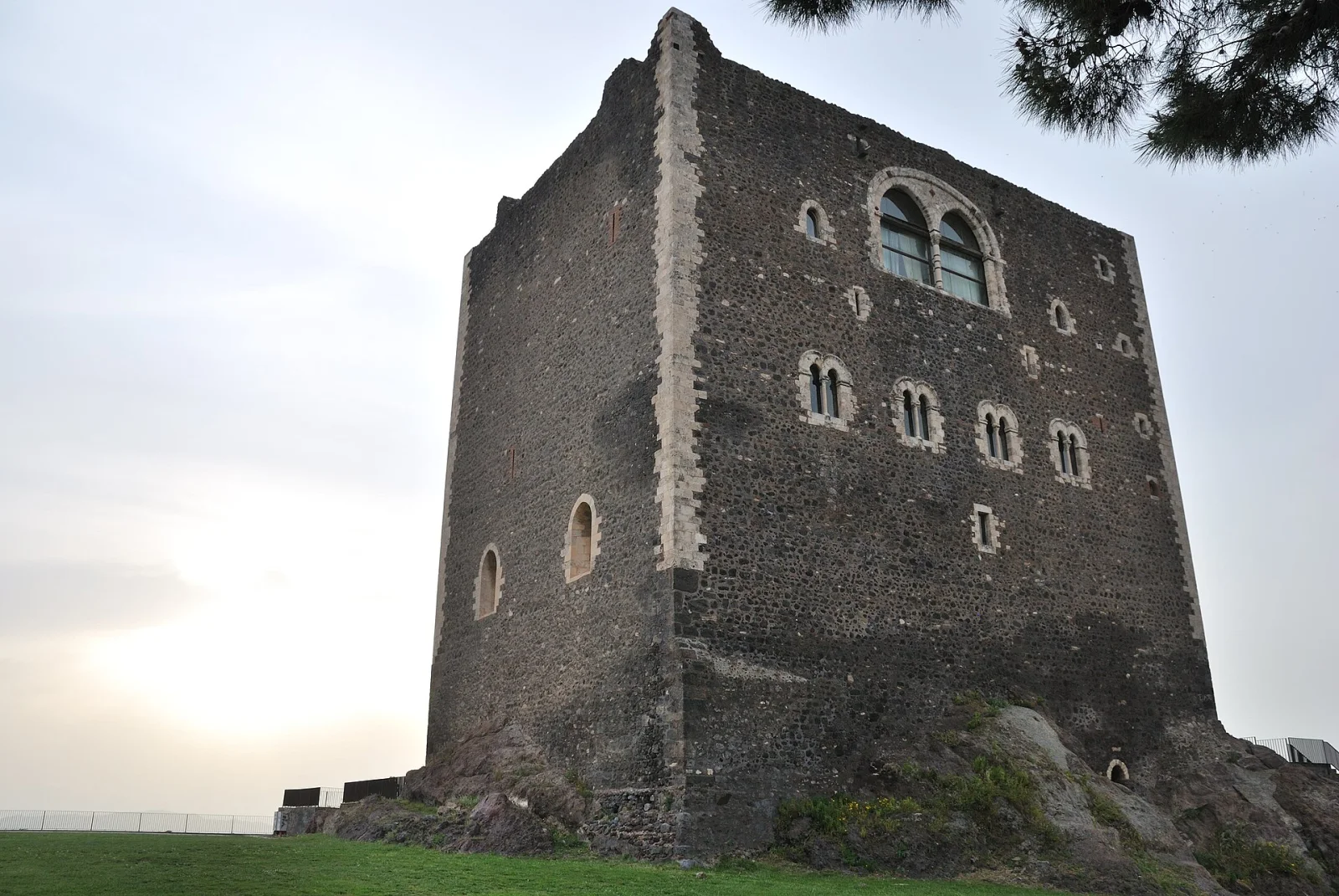
The Norman castle of Paternò is a keep built on a rise, at the top of the town's historic hill. Great Count Roger had it built in 1072 to protect the Simeto valley from Islamic raids and to control the territory: he had just besieged Catania and was planning to take Centuripe. The castle was assigned to Roger's daughter, Flandrina, and the population grew around it, including people from northern Italy drawn by the privileges granted by the Normans.
What to see
In 1195 Henry VI of Swabia assigned the county of Paternò, with the castle as its seat, to Bartholomew of Luci; later kings and queens stayed here, including Frederick II of Swabia, Eleanor of Anjou and Blanche of Navarre, and by grant of Frederick II it passed to Galvano Lancia. Used as a prison in the eighteenth century, it fell into decay, but since the late nineteenth century several restoration campaigns have given it back its bulk. The building is rectangular, 34 metres high, with walls more than two and a half metres thick, inside which the stairs are built, as in Anglo-Norman keeps. From Swabian times it was crowned by Ghibelline merlons, of which only stumps remain; the contrast between the dark stone of the walls and the white limestone frames of the openings is its most recognisable feature.
You enter through a pointed-arch portal. On the ground floor, divided into four rooms by two crossing walls, is the small chapel of San Giovanni with frescoed walls, next to the guardroom and the cells. A staircase rises to the hall of arms, lit by four mullioned windows; on the floor above is the great state hall of the court, with two mullioned windows looking out on one side to Etna and on the other to the Simeto valley.
Visiting
The castle dominates the town from the historic hill. Opening times and how to visit should be checked beforehand.
Our editors' tip
From the state hall a staircase leads to the terrace, enclosed by low walls that once had merlons: from up there the view takes in the whole town and the plain of Catania.


