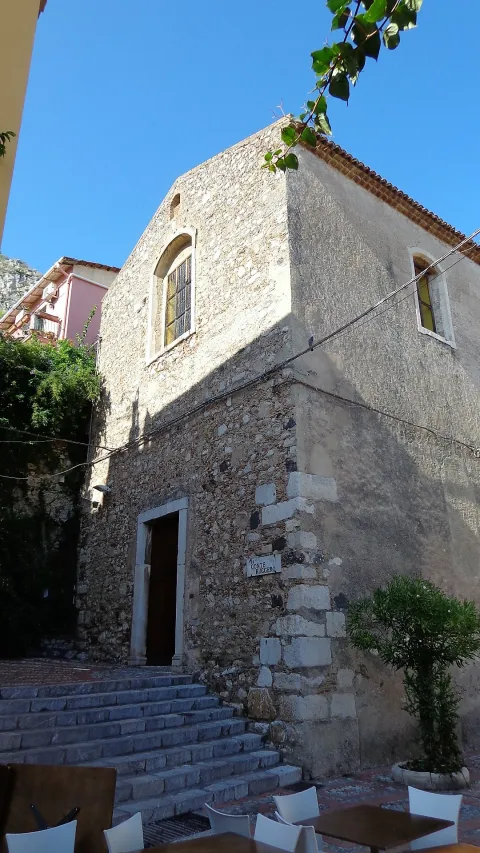
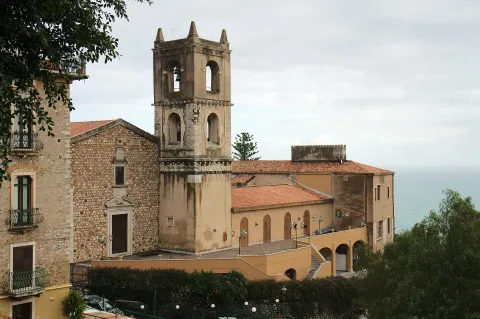
The museum is inside the Badia Vecchia, the 14th-century tower that formed part of the defences of Taormina's walls and was later dressed up with Ghibelline battlements, two-light windows of differing designs and the bands of polychrome inlay — pale stone alternating with lava stone — that recur at the nearby Palazzo Duchi di Santo Stefano. The name comes from an abbey said to have had its seat here. Once the building had been recovered, the Archaeological Museum of Taormina was installed in it, showing the material from the excavations carried out in the town between 1984 and 1998 by the Messina heritage office: things that came out from under the houses and streets of the centre, not from some distant site.
What to see
Three rooms, a short and dense route. The rarest piece is the statue of a priestess of Isis from the 2nd century AD, evidence of the cult of Isis and Osiris at Taormina; beside it stand late Hellenistic sculptures and pottery starting in the 4th century BC.
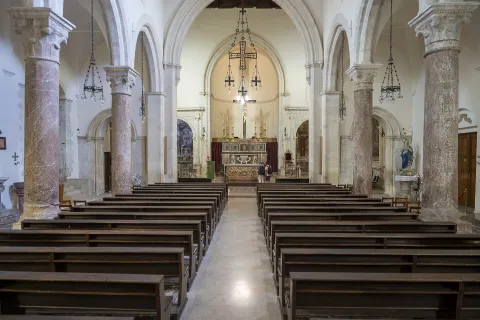
Then comes the Roman part: vessels recovered from imperial-age cisterns, thin everyday glass, alabaster urns and glass cinerary jars from the necropolises, a marble sarcophagus with Psyche and Dionysian figures. In the middle of it all is the building itself: the two-light windows frame the sea, and the rooms keep the narrow proportions of the tower.
Visiting
The Badia Vecchia is at via Circonvallazione 30, the upper street that runs above Corso Umberto; from the Ancient Theatre it is a five-minute walk. Entry is free. The hours change with the season — usually Tuesday to Saturday, 9:00 to 20:00 — and it is worth checking them before climbing up, since the museum belongs to the Naxos and Taormina archaeological park and follows its calendar. Thirty minutes will do, forty if you stop to read the labels; the rooms are on several levels and you go up on foot.
Our editors' tip
Put it before the Ancient Theatre, not after: once you have seen the urns, the glass and the priestess, the theatre stops being a postcard and becomes the most visible piece of a town that keeps giving up material from beneath its own houses. And before going in, cross the street: only from there, at the right distance, does the inlay of the facade read for what it is, a drawing done with two colours of stone.