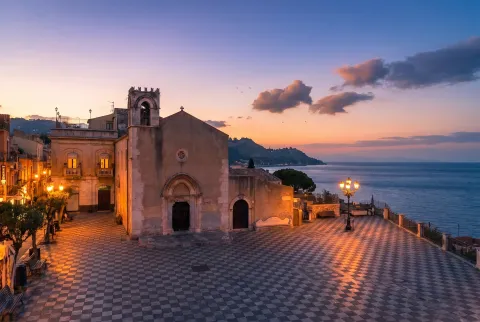
On 3 April 1374, Dominican friar Damiano Rosso, Prince of Cerami, initiated the founding of the convent of San Domenico and the adjoining church of Sant'Agata in Taormina, donating his family palace built over an earlier baronial fortress. Situated in Piazza San Domenico, the two buildings form a single monumental complex.
What to see
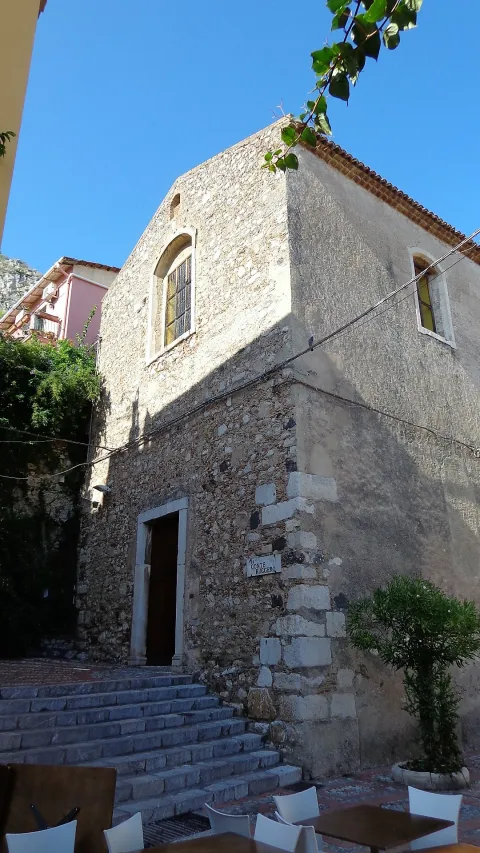
The most complete surviving element of the original church is its square Romanesque bell tower, divided into tiers with single-light lancet windows in the upper belfry levels. The main doorway features fluted columns topped with composite capitals. Access to the former convent is through a 17th-century portal crowned by the carved marble emblem of the Dominican Order, depicting a dog carrying a lit torch in its jaws.
The complex houses two cloisters. The Renaissance-style main cloister features a square layout with seven arches on each side resting on 29 columns, containing the sarcophagus of Giovanni Corvaja and a central well drawing from a Roman underground cistern. The smaller, older cloister features six arches per side set on 25 columns.
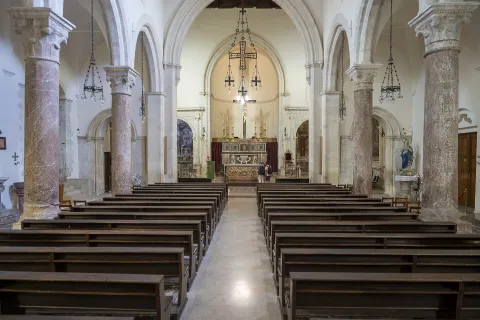
Much of the church interior was destroyed on 9 July 1943 during Allied air raids targeted at the German high command stationed in the adjacent hotel—a building created in 1896 by converting the friars' 40 cells. The bombing ruined the inlaid Taormina marble, choir, and wooden carvings. However, a 16th-century Renaissance marble statue of Saint Agatha attributed to Martino Montanini survived and was relocated to the cathedral of San Nicola di Bari. The surviving ruins, including fragments of minor altars, were reconfigured after the war as a conference hall. Historic inventories also record busts of Damiano Rosso, statues of Saint Francis and Saint Dominic, and frescoes depicting Irish Dominican martyrs Honoria Magaen and Honoria de Burgo.
Visiting
Visitors can view the intact Romanesque bell tower, the 17th-century convent portal, the two cloisters, and the surviving altar bases integrated into the post-war conference hall area.
Our editors' tip
Pay close attention to the central well in the main cloister, which taps directly into an ancient Roman underground cistern situated right at the heart of the Renaissance colonnade.