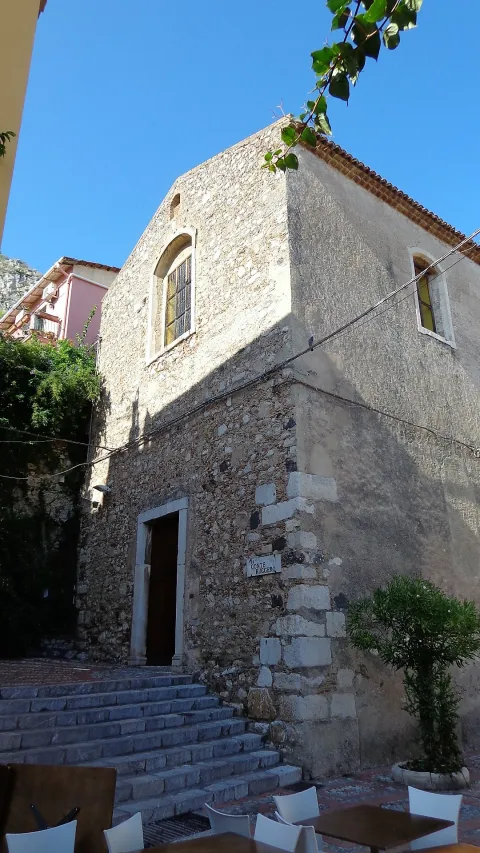
Standing nearly 400 meters above sea level on the rocky height overlooking Taormina, the Castle of Monte Tauro occupies the site of ancient Tauromenion's lower acropolis. Known in historical medieval texts as the castrum inferior to distinguish it from the upper citadel at Castelmola, the location was first fortified during the Byzantine era as a defensive outpost against Arab raids. Following repeated sieges during the 9th and 10th centuries, the fortress fell under Arab rule in 969. In 1078, the Norman Great Count Roger secured the site by building twenty-two wooden siege towers around the area to cut off supply lines.
What to see
The remaining structure displays the hallmarks of Swabian military architecture implemented under Emperor Frederick II during the 13th century, alongside 15th-century restorations to the curtain walls. The elevated position offers expansive views stretching from the Strait of Messina in the north down to the Alcantara River valley and Mount Etna in the south, extending toward Catania and the Peloritani mountains to the west. On the same rocky outcrop sits the Sanctuary of Madonna della Rocca, founded around 1640. Historically, the Malvicino Tower was also erected between this castle and Castelmola under King Louis of Sicily.
Visiting
Documented in 1154 by Arab geographer al-Idrisi in the Book of Roger as a stronghold atop the crag, the castle served as a strategic military seat for centuries. Governance of the fortification passed through several prominent dynasties, including the Lucchesi Palli, Asmundo, Spadafora, and Balsamo families. The site links medieval Swabian wall remnants directly with the 17th-century sanctuary built onto the ridge.
Our editors' tip
Pay attention to the natural defensive lines overlooking the Alcantara valley and the slopes of Mount Etna. Examining the orientation of the walls makes clear why Count Roger relied on a ring of twenty-two wooden towers to completely isolate the stronghold during the siege of 1078.