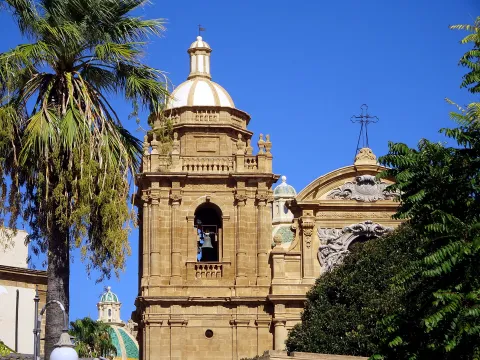
In the late 1990s a bronze statue rose from the bed of the Sicily Channel: the Dancing Satyr, given back by the sea off Mazara del Vallo. The regional government of Sicily built this archaeological museum around that find in 2003, installing it inside the former church of Sant'Egidio.
What to see
The piece that gives the museum its name is the bronze Dancing Satyr, displayed at the centre of a single large hall. Around it sit the other objects returned by the sea: pottery and fragments of bronze statuary brought up by the excavation and research campaigns carried out in the waters off the Mazara coast. There are medieval terracotta braziers, a North African spatheion from the 5th century AD, a plain askos from the first half of the 3rd century BC, and several transport amphorae of Punic and Roman date. Together they trace centuries of Mediterranean sailing and trade, read through what the water happened to keep.
Visiting
The museum unfolds in one large hall. A documentary film about the recovery of the Satyr plays at the entrance, worth watching to understand how and where the statue surfaced before you stand in front of it. Since 2019 the museum has come under the Archaeological Park of Selinunte, Cave di Cusa and Pantelleria, which coordinates it alongside the other sites in the district.
Our editors' tip
Watch the documentary at the entrance before you approach the statue: knowing the circumstances of the recovery at sea changes how you look at the bronze. And since the Satyr has the room to itself, take the time to walk around it, because the dancing pose reads differently from every side.