Founded in 650 BC by Greek colonists from Megara Hyblea, Selinunte derives its name from sélinon, the wild celery that grew along the southwestern coast of Sicily and was minted onto the city's first silver coinage around 550 BC. Covering 2.7 square kilometres between the mouths of the Belice and Modione rivers in the municipality of Castelvetrano, it stands today as the largest archaeological park in Europe.
What to see
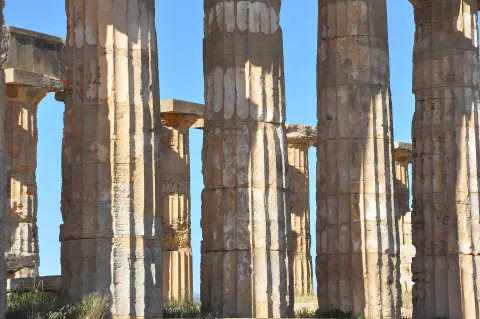
The urban complex spreads across several plateaus linked by an isthmus. To the south, the walled acropolis features a grid plan aligned along two primary thoroughfares and holds the remains of five sanctuaries designated as Temples A, B, C, D, and O. Temple C is among the most important archaic structures on the site; in 1823, English architects Samuel Angell and William Harris unearthed its carved metopes, which are now kept in the Regional Archaeological Museum of Palermo, with additional finds displayed in the civic museum of Castelvetrano. On the eastern hill stand Temples E, F, and G, the latter being one of the largest sacred structures of the ancient Greek world. North of the acropolis lay the residential quarter built on a Hippodamian plan, bordered by the necropolises of Galera-Bagliazzo, Manuzza, and Buffa.
Visiting
The site allows visitors to walk through the acropolis and examine the fortifications rebuilt by the Syracusan commander Hermocrates following the Carthaginian siege of 409 BC led by Hannibal Mago. Reidentified in 1551 by the Dominican scholar Tommaso Fazello through ancient texts after centuries of obscurity — when Arab writers called it Rahl'-al-Asnam, or the "village of pillars" — the ancient settlement preserves its striking urban layout above the Mediterranean shore.
Our editors' tip
To fully appreciate the architectural sculpture of Selinunte, pair your walk through the ruins with a visit to the archaeological museum in Palermo, where the original metopes recovered from Temple C are on display.