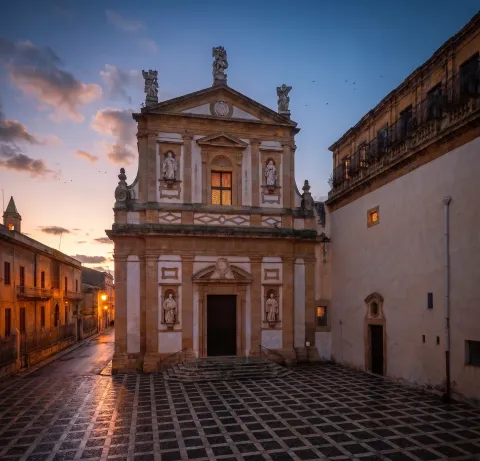
Roger I vowed to build it during his 1072 battle against the Saracens, and the cathedral of the Holy Saviour rose as his thanksgiving — raised between 1086 and 1093 under Etienne de Rouen, on the ruins of an earlier basilica the Saracens had razed in 828. It is the mother church of the Mazara del Vallo diocese, and beneath its Baroque skin it still keeps the Norman plan the Great Count wanted.
What to see
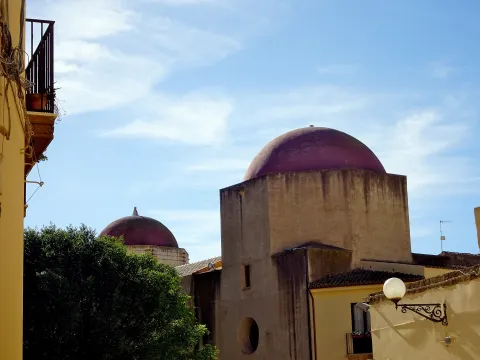
The front follows the Northern European models the Normans brought south — twin towers, a transept closing in three apses in the Cluniac manner — though a Baroque casing was modelled over it in the seventeenth century. Inside, three naves run on Tuscan columns and round arches; domes rise over the crossing and the transept arms, sheathed outside in coloured maiolica. The central, elliptical one frames a Last Judgement frescoed by Rosario Spagnolo of Cefalù between 1910 and 1914. The great set piece stands in the presbytery: the Transfiguration on Mount Tabor, six marble figures — Christ transfigured, Moses, Elijah, Peter, James and John — commissioned from Antonello Gagini in 1532 and finished by his son Antonino in 1537. In 1576-77 bishop Antonio Lombardo took the group apart to build an artificial mountain suggesting Tabor's slopes. The Gaginis return in the transept, in Antonello's ciborium and a 1537 statue of Saint Vincent, while the Chapel of Maria Santissima del Soccorso holds Domenico Gagini's Madonna del Soccorso and a thirteenth-century fresco of Christ Pantocrator. In the right nave, the Portal of Saint Giles — marble carved by Bartolomeo Berrettaro in 1525, its eight panels telling the saint's life — stands before two Roman sarcophagi showing an Amazonomachy and the Hunt of Meleager.
Visiting
Set beneath the triumphal arch is a painted wooden Cross by an anonymous thirteenth-century Sicilian master, Christ crucified on one face and the Agnus Dei among the four evangelists' symbols on the other. The stuccowork along the naves rewards a slow look, above all Pietro Orlando's in the central nave. The church you walk through today is the rebuilding begun on 18 June 1690 by bishop Francesco Maria Graffeo, to a design by Pietro Castro of Trapani, and completed in 1694; in 1980 John Paul II raised it to a minor basilica.
Our editors' tip
Come when the light rakes in from the side: the maiolica domes and the gilded sunburst in the Chapel of the Blessed Sacrament change entirely. And do not settle for the Transfiguration seen from the nave — step up to the two side niches of the presbytery, where the kneeling figures of bishop Antonio Lombardo and Count Roger look out, the two men who, five centuries apart, tied their names to this church.