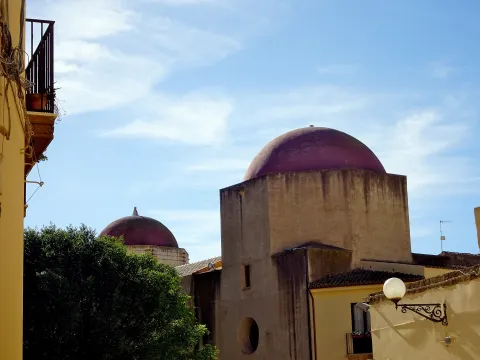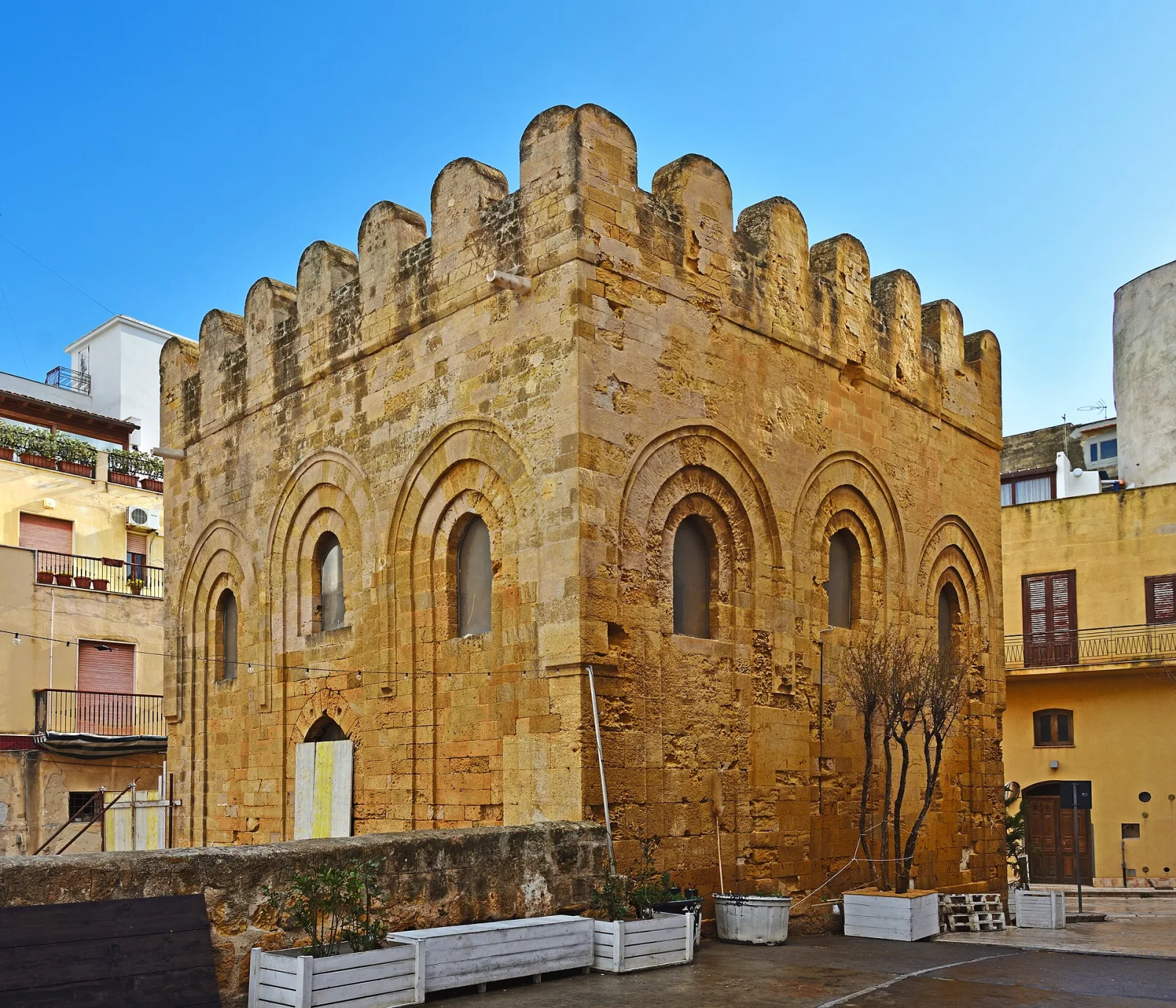
Built in 1124 on the left bank of the Mazaro, in the middle of Mazara del Vallo's old town, San Nicolò Regale is one of the buildings that best explains Norman Sicily. Its square plan, capped by a dome resting on a broad, low cubic drum, belongs to the family of the cube: the domed structures that Norman builders raised using models of Islamic descent.
What to see
From outside, the church reads as a compact square crowned with merlons and closed at the top by a hemispherical dome. Three apses project from the body of the building, a feature that links San Nicolò Regale to San Cataldo in Palermo, its contemporary, and to the church of the Santissima Trinità di Delia near Castelvetrano. Inside, the space is organised around four central columns, with slender colonnettes tucked into the corners of the three apses and a small altar at the far end. The floor keeps a coloured design of Islamic inspiration, a reminder of the visual culture the Arabs brought to the island. Anyone who has seen San Cataldo will recognise the same grammar of forms, the same geometric restraint.
Visiting
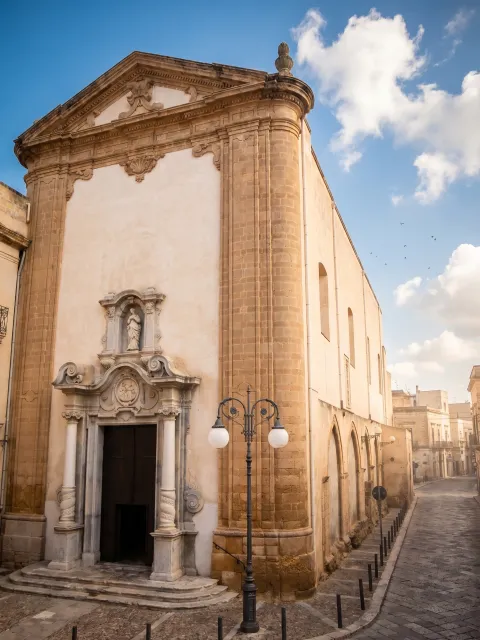
The real surprise lies below the pavement: in 1933 the base gave up traces of Roman mosaics from the late imperial period, proof that the site was in use long before the Norman foundation. What stands today, though, is the result of a long recovery. Between the seventeenth and eighteenth centuries the building was reworked to Baroque taste, given an octagonal plan and a pitched roof; a first attempt to return it to its original shape came in 1947, but only in the 1980s did the monument recover its medieval appearance. It is also documented as a seat of the Equestrian Order of the Holy Sepulchre of Jerusalem.
Our editors' tip
Approach from the river side first, where the cubic block and the dome can be read in full before you step inside. Once in, look for the level of the basement: it is the quickest way to grasp how many centuries this small temple has crossed, from the Roman mosaics to its Arab-Norman rebuilding.