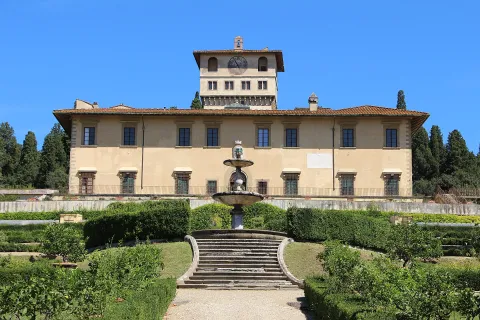
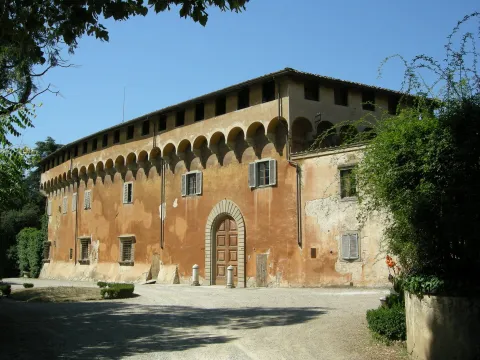
The palace is the work of Michelozzo, commissioned by Cosimo the Elder. Cosimo had first asked Brunelleschi for a design and rejected it because it was too magnificent: it would have stirred the envy of his fellow citizens. Vasari tells the story, and it should be said that no other trace of that design survives. His fears were not unfounded: ten years earlier Cosimo had been accused of tyranny by his political enemies, imprisoned in Palazzo Vecchio and exiled to the Veneto, from which he had returned to acclaim. Michelozzo built him a cube, imposing outside but austere, around a square courtyard with Corinthian columns, and that became the model of the Florentine Renaissance palace: Palazzo Strozzi comes from it too.
What to see
The private chapel, known as the Chapel of the Magi, was frescoed in 1459 by Benozzo Gozzoli, a pupil of Fra Angelico, for Piero the Gouty, who followed the work himself. Across the three main walls runs the Cavalcade of the Magi, and the religious subject is mostly a pretext: in the procession are portraits of the family and of the political figures who had come to Florence at the Medici's invitation, a very young Lorenzo, his father Piero, his grandfather Cosimo. On the altar there is a late fifteenth century copy, because the Nativity by Filippo Lippi that stood there is now in Berlin. Later, when the Riccardi built their grand staircase, a corner was cut off the chapel rather than pull it down.
Visiting
It is worth looking at the courtyard while thinking of what it held. At the close of the fifteenth century Donatello's David stood here, and in the Magnificent's bedroom hung the three panels of Paolo Uccello's Battle of San Romano. In the park to the north, bought by Lorenzo's wife Clarice Orsini, the antique sculptures acquired largely in Rome served as models for young artists studying under the sculptor Bertoldo: it was the first thing in Europe resembling an academy of fine arts, and the most important of its pupils was Michelangelo, who spent his adolescence in this palace.
Our editors' tip
In 1659 grand duke Ferdinando II, who by then lived in Palazzo Pitti, sold the old family palace to the Riccardi, bankers. They doubled it, losing the cubic shape, but on the new front they kept the fifteenth century style out of respect for Michelozzo and for the previous owners. From their time comes the Gallery of 1685, with the vault painted by Luca Giordano, whom people called Luca fa presto for the speed at which he worked: he put there the Apotheosis of the Medici, the protectors of the new masters of the house. Two things to look for: in the garden an antique headless statue, perhaps a Hercules, onto which the head of marquis Francesco Riccardi was grafted during the works; and the small secret seventeenth century room in the mezzanine, entirely frescoed with false architecture, forgotten for at least 170 years and found again only at the end of the nineteen eighties during a measuring survey. Why it was forgotten, nobody knows.