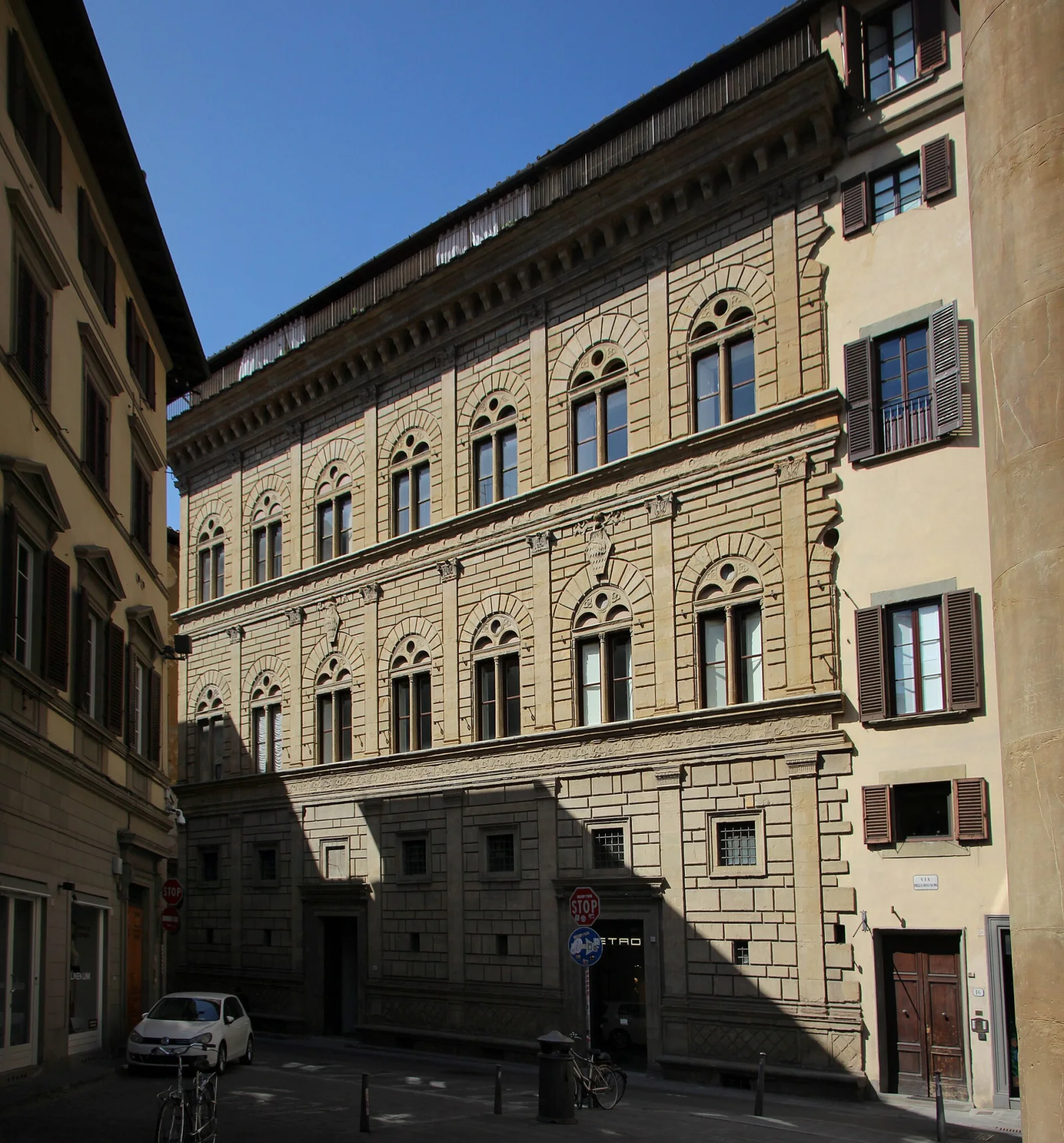
Via della Vigna Nuova is too narrow to look properly at Palazzo Rucellai, and that is the first joke Leon Battista Alberti plays on passers-by: the most studied façade of the Florentine Renaissance will not let you take it in at a glance. The client was Giovanni Rucellai, a very rich wool merchant, who bought his neighbours' houses one at a time and then wrote in his notebook the sentence that explains everything: out of eight houses I have made one. Alberti designed the skin that holds the eight houses together; Bernardo Rossellino built it, in the fourteen-fifties and sixties.
What to see
The façade is the first private house in Europe in which the three classical orders — Tuscan, Ionic, Corinthian — are stacked over three storeys as at the Colosseum, but flattened into pilasters that barely project. The wall is covered with a regular grid of imitation rustication, and every horizontal and vertical line is measured against the others: Alberti had written in De re aedificatoria, of 1452, that a building should command respect through its proportions and not through display, and here he proves it. He himself, with false modesty, called his own work mere wall decoration.
Look at the right-hand edge, level with the last row of windows: the stone is left toothed, the joints ready for bays that were never built, because the neighbour would not sell. Along the frieze run the Rucellai emblems, the sail filled by the wind of Fortune and the ring with the diamond, the same ones Giovanni had placed on the front of Santa Maria Novella, which he paid for and Alberti again designed. Opposite, across the little square, stands the family loggia, put up for the wedding of his son Bernardo to Nannina de' Medici.
Visiting
The palace still belongs to the Rucellai and is seen from outside: the interiors are not open to the public, except for events and special openings. It stands halfway along via della Vigna Nuova, five minutes from piazza Santa Maria Novella and as many from the Ponte Vecchio; the square in front is just wide enough to stop in. A quarter of an hour, to be paired with the front of Santa Maria Novella to understand what the client had in mind.
Our editors' tip
Put your back against the loggia, in the far corner of the little square: it is the only point in the street from which you can see all three orders one above the other. Then go up to the wall and run your hand over the rustication: it is fake, cut into smooth stone with a thin groove. The whole palace is a surface pretending to be a construction.