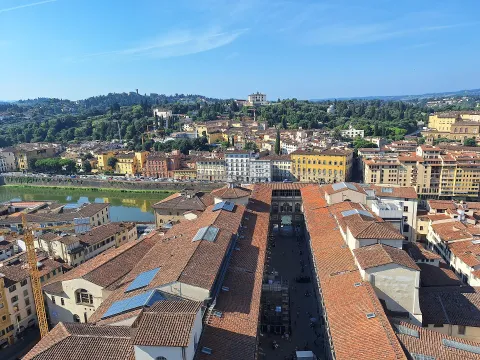
On 27 September 1594 a decree of Ferdinand I de' Medici evicted the butchers, who had worked the bridge since 1442 and tipped their waste into the Arno, and handed the shops to goldsmiths and jewellers: the Vasari Corridor ran over their heads and the grand duke disliked the smell. The trade has not changed since. The present structure, on three arches, dates from 1339-1345, built after the flood of 4 November 1333 swept away its predecessor together with the statue of Mars that Florentines treated as a talisman of the city. Vasari credited the design to Taddeo Gaddi; modern scholars lean towards Neri di Fioravante. In 1495 the city sold forty-eight shops to private owners, who extended them out over the water on brackets: hence the lopsided profile you see from Ponte Santa Trinita.
What to see
The three arches are segmental: the central one spans 30 metres, the side ones 27, with a span-to-rise ratio of 5 to 1. For the fourteenth century that was a daring solution, and it let carts cross without a steep climb. At the centre the bridge opens into a small piazza with four fourteenth-century doorways still in place and a clear view of the Arno: the only spot where you notice you are on a bridge and not in a street.
On the eastern parapet stands the bronze bust of Benvenuto Cellini, cast by Raffaello Romanelli in 1900 for the four hundredth anniversary of the goldsmith's birth and paid for by the jewellers of the bridge. Above the shops runs the Vasari Corridor, 760 metres built in five months in 1565 to link Palazzo Vecchio with Palazzo Pitti without going down into the street. At the south-east corner the Torre dei Mannelli did not give way: its owners refused demolition and Vasari had to bend the corridor around it on a row of brackets that are still visible.
Visiting
The bridge is public, always open and free; you reach it on foot from Via Por Santa Maria or Via de' Guicciardini, and no cars cross. Walking over takes three minutes, looking at it takes longer, because the best photograph is not taken on the bridge but from Ponte Santa Trinita, two hundred metres west, where you see the overhanging shops and the seventeenth-century back rooms leaning over the water. Between ten in the morning and six in the evening the crowd is solid and the goldsmiths' windows are open; the Vasari Corridor is visited separately, entering from the Uffizi.
Our editors' tip
Go at dawn, around seven: the shutters are still down and for half an hour the bridge becomes what it actually is, a row of timber and stone huts propped on three arches. Then walk down to Lungarno Torrigiani and look at it from below, where the piers go into the water. And do not attach padlocks: between 2005 and 2006 the council removed 5,500 of them from the railing around the Cellini bust, and there is now a fine.