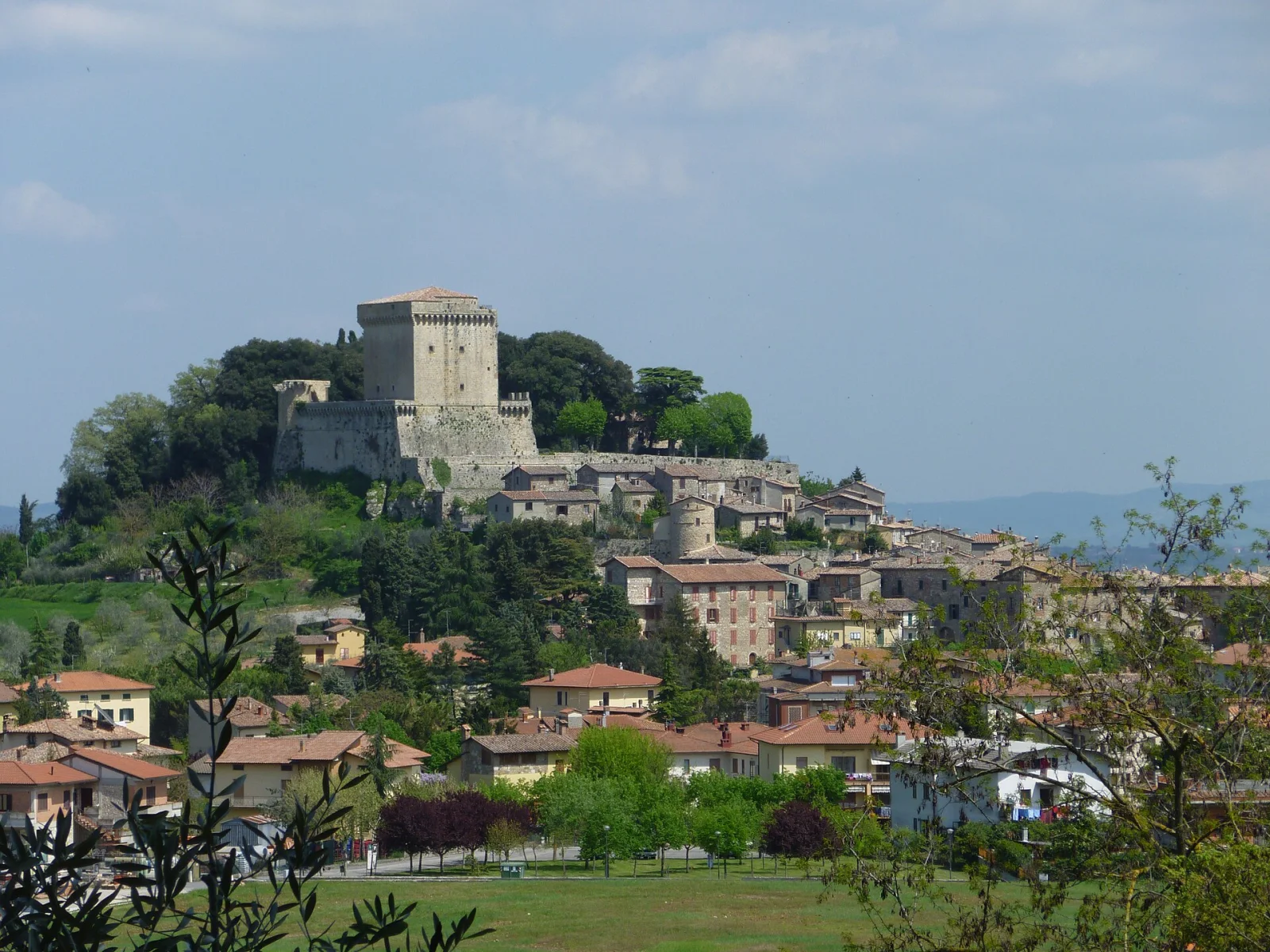
Under Sarteano opens the Bear's Cave, a karst cavity explored by the village's caving group after 1954 and systematically dug from 1960. Inside, groups of Bronze Age vases came to light, some of them whole and still full of grains of wheat: not things fallen there by chance, but deposits made on purpose, tied to some rite we cannot read. The cave was frequented from the Neolithic until the eleventh century before Christ, and in another cavity of the territory, the Toad's Hole on monte Cetona, vases had been set to gather the water dripping from the rock. Then came the Etruscans, who left here the canopi — cinerary vases with a human head, typical of this area — and who in the sixth century before Christ moved the settlements onto lower hills, to be nearer to Chiusi, then at its best moment.
The greatest discovery is recent. Since 2000 the Pianacce necropolis has been investigated by the civic archaeological museum and by the Etruria archaeological group, and out of it came the tomb of the infernal quadriga, painted in the second half of the fourth century before Christ in colours still vivid: a demon with red hair drives a chariot drawn by two lions and two griffins, and he is almost certainly Charun, the Etruscan Charon, in the only known image that shows him driving while he escorts the souls to Hades. Around him are a banquet, a three-headed serpent and a hippocamp, all in the underworld: the Etruscans of that century imagined it far more tormented than their grandparents did. In 2007, next to three hypogea, a theatre-shaped structure used for funerary rites came back to light. The village museum also keeps the cinerary statues of fetid stone found in 2006.