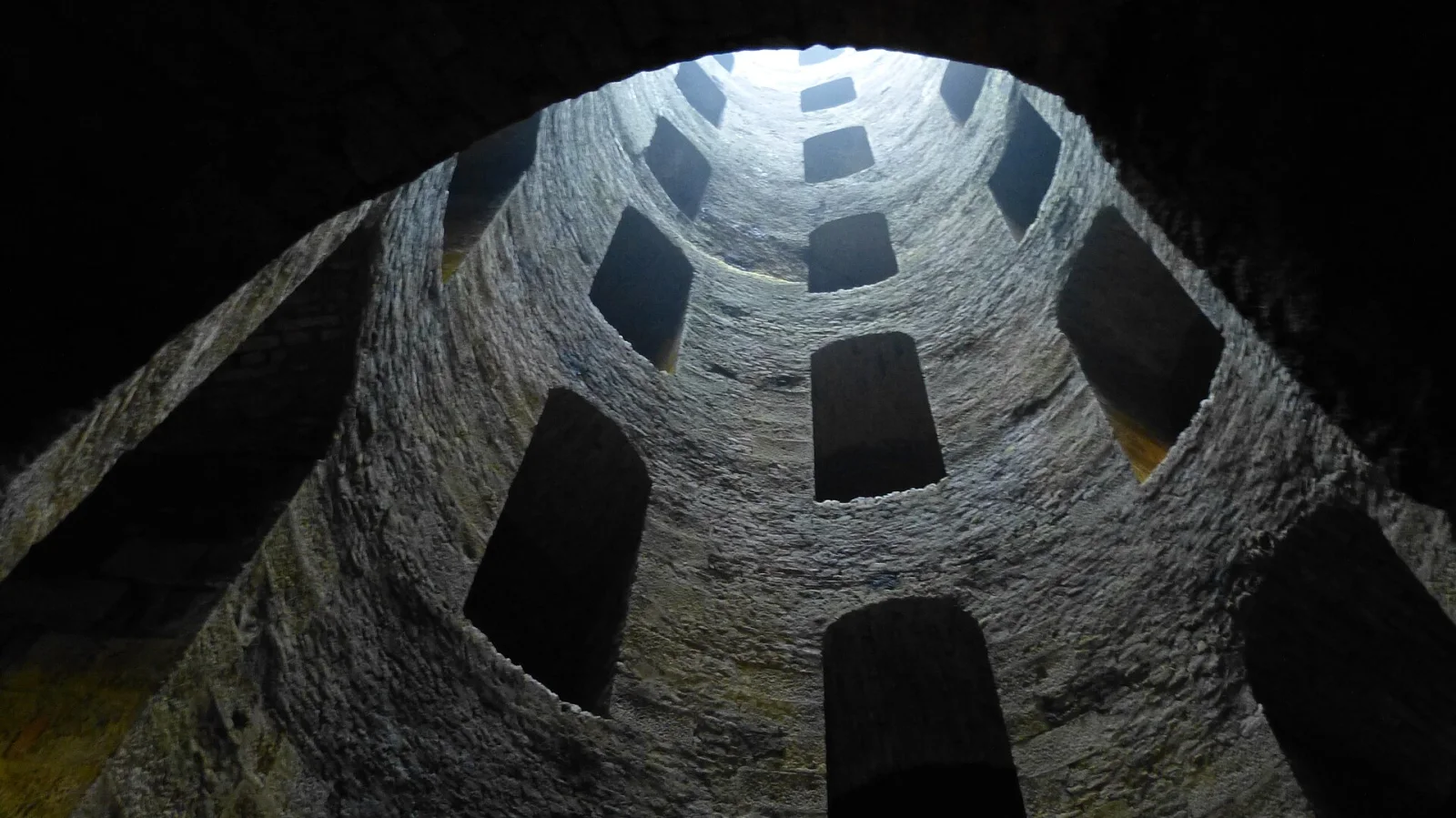
In 1527 Pope Clement VII fled Rome, sacked by the Landsknechts, and took refuge in Orvieto, which stands on top of a tuff cliff and is impregnable; but he realised at once that, if he were besieged, he would die of thirst. So he called Antonio da Sangallo the Younger and had him dig into the rock a well fifty-four metres deep, with two spiral staircases winding one inside the other without ever meeting: the mules went down through one door with empty barrels and came up through the other with full ones, never crossing paths. It was finished in 1537, under Paul III, and for centuries it was called the well of the Rocca; the name of Saint Patrick was given to it by nineteenth-century friars, thinking of the Irish cave from which one descended to Purgatory.
What to see
The well itself, walked down: two hundred and forty-eight steps, wide and low because animals had to take them, and seventy-two large windows open onto the central void that give light and air as you go round. At the bottom, fifty-four metres below the city, a bridge crosses the water that a spring keeps always at the same level, and from there you look up: the double helix seen from below is one of the most impressive images of Renaissance engineering. Then you climb back by the other stair, and meet nobody coming down.
Over the door, the Latin inscription saying that what nature had begrudged, ingenuity supplied; outside, the low cylindrical structure with the Farnese lilies and the two opposite entrances. Clement VII had Benvenuto Cellini strike a coin to celebrate it, with Moses drawing water from the rock and the words so that the people may drink: it is in the Vatican Museums. Beside the well, the Albornoz fortress with its garden and the view over the valley, and two hundred metres away the Etruscan temple of the Belvedere.
Visiting
The well is on Piazzale Cahen, where the funicular from the station arrives, five minutes from the Duomo by shuttle bus; its own ticket, combinable with the Orvieto Carta Unica, open every day with longer hours in summer. Three quarters of an hour, counting the climb. It is not suitable for those with walking difficulties or who feel the cold: at the bottom it is fifteen degrees even in August, and the damp is noticeable.
Our editors' tip
Go down without stopping and count the windows, then at the bottom cross the bridge and look up towards the circle of sky: from there you understand how the double helix works, and why in Italian people still say something is like the well of Saint Patrick when it can never be filled. On the way up, try to meet someone: you will not manage it, and that is exactly what Sangallo wanted.


