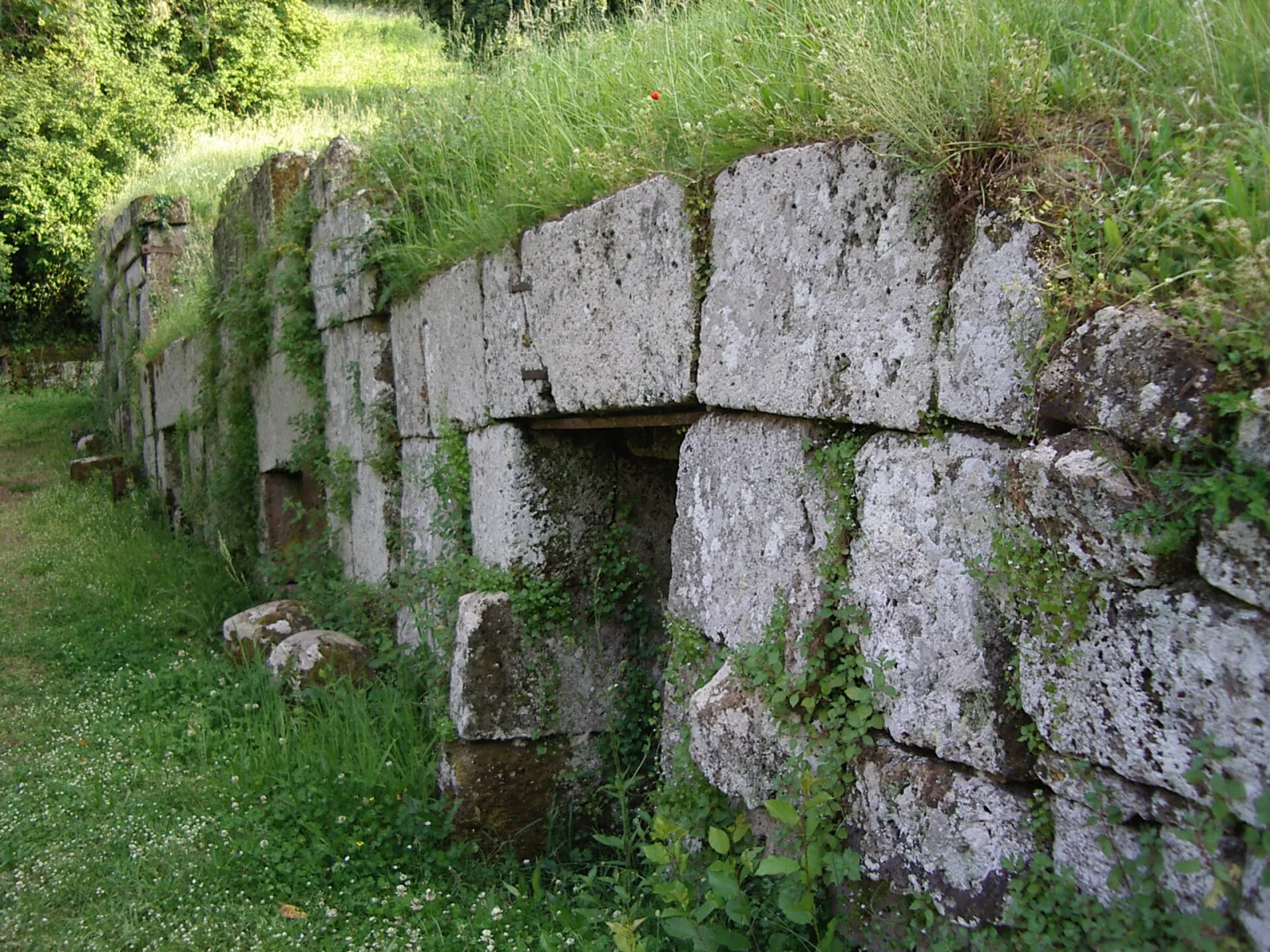
At the foot of the Orvieto cliff the Etruscans built a city for the dead, with streets on a grid and regular blocks, the way they built the city of the living. There are more than two hundred tombs, all chamber tombs and nearly all of the same size, three metres by two: no great mounds for the powerful, as at Cerveteri, but rows of identical houses.
What to see
Each tomb is made of tufa blocks and you go down into it by three steps. Against the back wall and along one side run the benches on which bodies or ashes were laid; the roof is a double pitch, formed of blocks that project further and further towards the centre. It is not a true vault: what held it together was the earth heaped above.
On the lintel of the door the name of the dead person and of their family was cut, and those inscriptions can still be read. Above the roof stood markers whose shape indicated the sex of the buried, though which shape meant which we no longer know. The grave goods held bronzes, bucchero ware, Attic vases in black and red figure, spears and spits for the men, ornaments for the women.
Visiting
The necropolis is below the cliff, along the road that circles the town, and can also be reached on foot going down from porta Maggiore; entry is by ticket, with hours that change with the season, and the ground is uneven. An hour.
Our editors' tip
Walk along one funerary street reading the names on the lintels, one after another, at eye level: it is the list of the inhabitants of a vanished city, written on the front door. Then look at the tombs: they are all the same. That is the most striking thing about this place, and it has nothing to do with archaeology.


