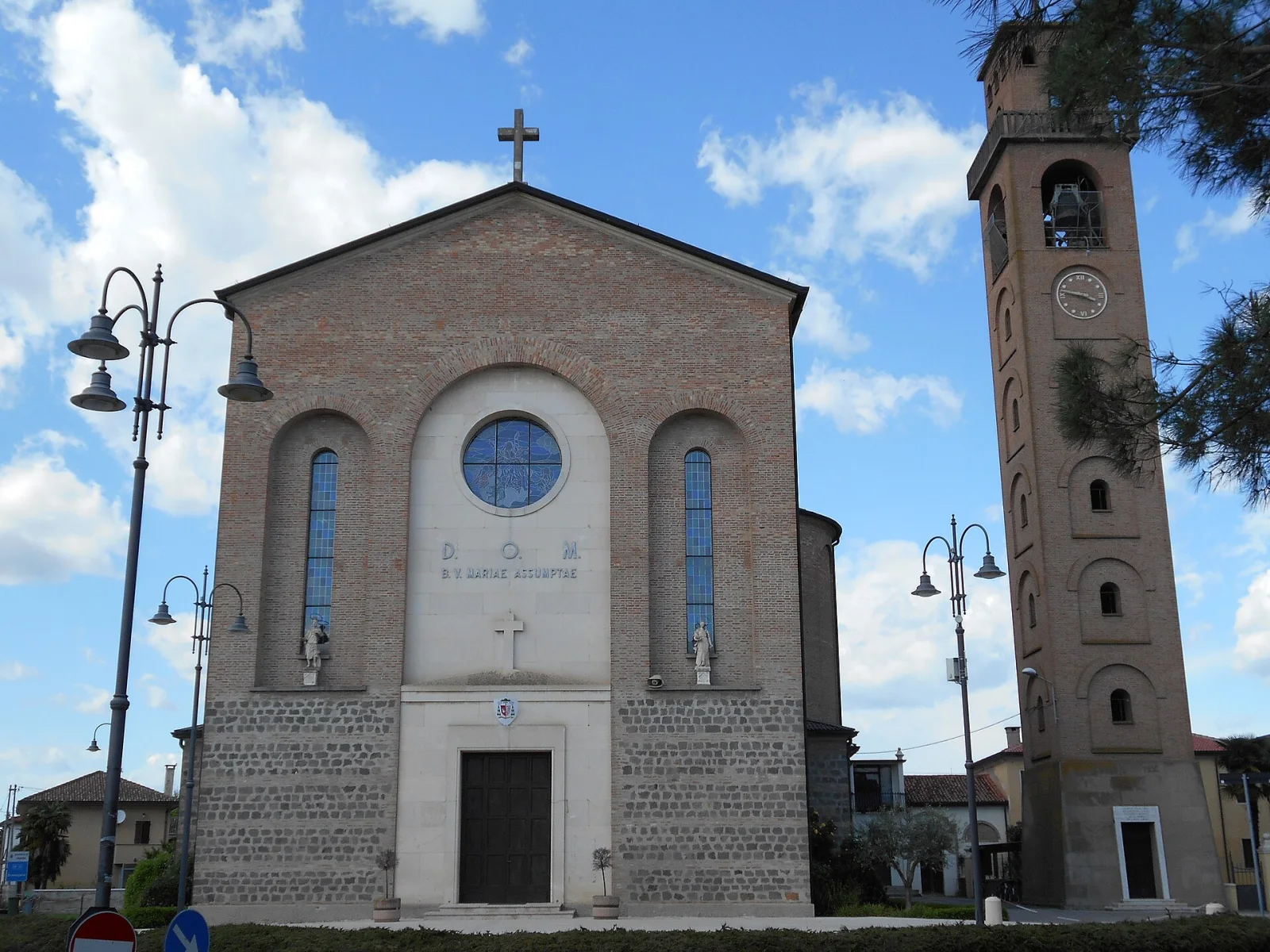
Ponso means a stop. The name comes from pausum or palsum, that is locus ubi pausatur, the place where one halts, and in the first notarial acts of the twelfth century it is found written in every possible way — Passim, Pausum, Piusum, Palsum — while at the time of bishop Pietro Barozzi's visit, in 1489, it had become Passium. For centuries it was a village of shepherds and fishermen, and the fishermen had something to work with: in the records of the Venetian Republic two stretches of water are named, the lake of Ponso and that of Vighizzolo. Today there is nothing left of those lakes and the territory is all vineyards and orchards; the water has remained only on the coat of arms.
For the coat of arms, granted in 1988, is a summary of the village made of figures. The chevron is a stylised tent, and it stands there for the name, that is for the resting place. The three lozenges are the three settlements of the comune: the main village, Bresega and Chiesazza. The silver fields are the lakes and marshes that once stretched here, and the ears of wheat are what came afterwards, when the water went away. At Chiesazza, then, there is the church of Santa Maria dei Pra', built around the year one thousand with material recovered from Roman works and decorated with frescoes now ruined; in the territory there is also Villa Fracanzani, of the seventeenth century, with its well-preserved barchesse. The village, which had become a comune in the Napoleonic age, was badly damaged by a fire in 1809.
Straight-line distances from the town centre. Tap a point to open its page.
Near Ponso
The closest destinations covered by our editors, with straight-line distance.


Places to see within 25 km
Outside Ponso, but an easy day trip away.