
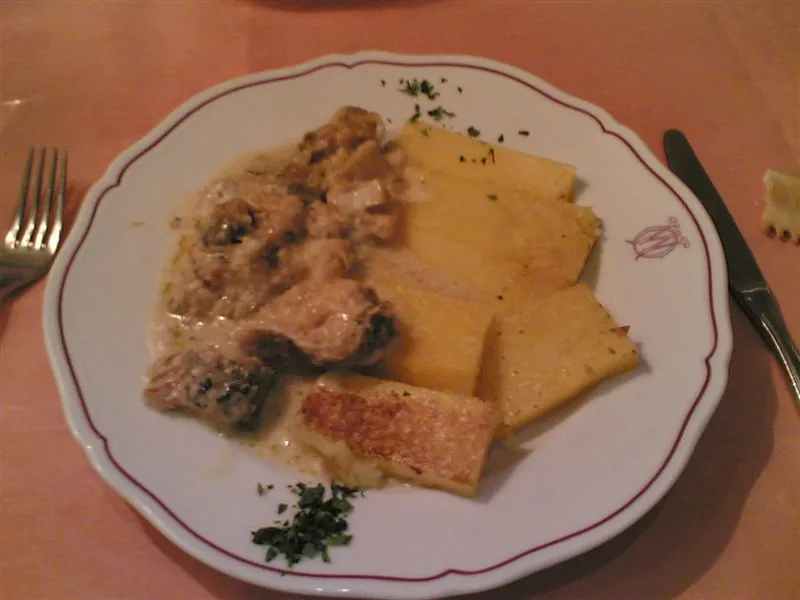
Baccalà alla Vicentina stockfish slow-cooked with milk, oil and anchovies
Stockfish, milk, oil and anchovies, cooked for hours over the lowest heat: baccalà alla vicentina arrived from Norway with a shipwreck in 1432.
Read more →Pedemonte stands on the left bank of the Astico, below the plateaux of Lavarone and Luserna, and is one of the smallest comuni in the Vicenza province; in Cimbrian it is called Dross. The names of its hamlets tell you what life was like here: Carotte comes from case rotte, broken houses, and Casotto from the casotti, the huts farmers kept on the valley floor while living up on the slopes, where it was safer. The first documented place is Brancafora, the hospice for pilgrims and travellers where the valley road forked towards Caldonazzo and Levico: it appears in a deed of 1154, and in 1199 Speronella, wife of Ezzelino II, left it ten lire.
From 1535 Pedemonte and Casotto belonged to the prince-bishopric of Trent and thus to the Habsburg empire, and there they stayed until the end of the First World War. In 1914 the young men of the village were conscripted into the Austro-Hungarian army and sent to the eastern front; in May 1915, when Italy entered the war, the whole population was evacuated and taken to huts at Braunau am Inn, in Upper Austria, among cold, hunger and disease, until the fighting ended. The village passed to the province of Vicenza in 1929, by will of the fascist government, but it kept the Austrian land registry, with the record book held in Trent. And in 2008, by referendum, its people asked to go back to the province of Trent.
Stockfish, milk, oil and anchovies, cooked for hours over the lowest heat: baccalà alla vicentina arrived from Norway with a shipwreck in 1432.
Read more →Straight-line distances from the town centre. Tap a point to open its page.
The closest destinations covered by our editors, with straight-line distance.
Outside Pedemonte, but an easy day trip away.


