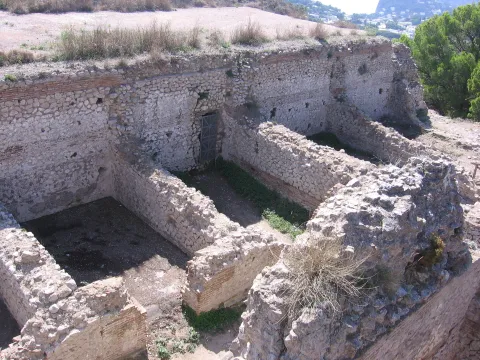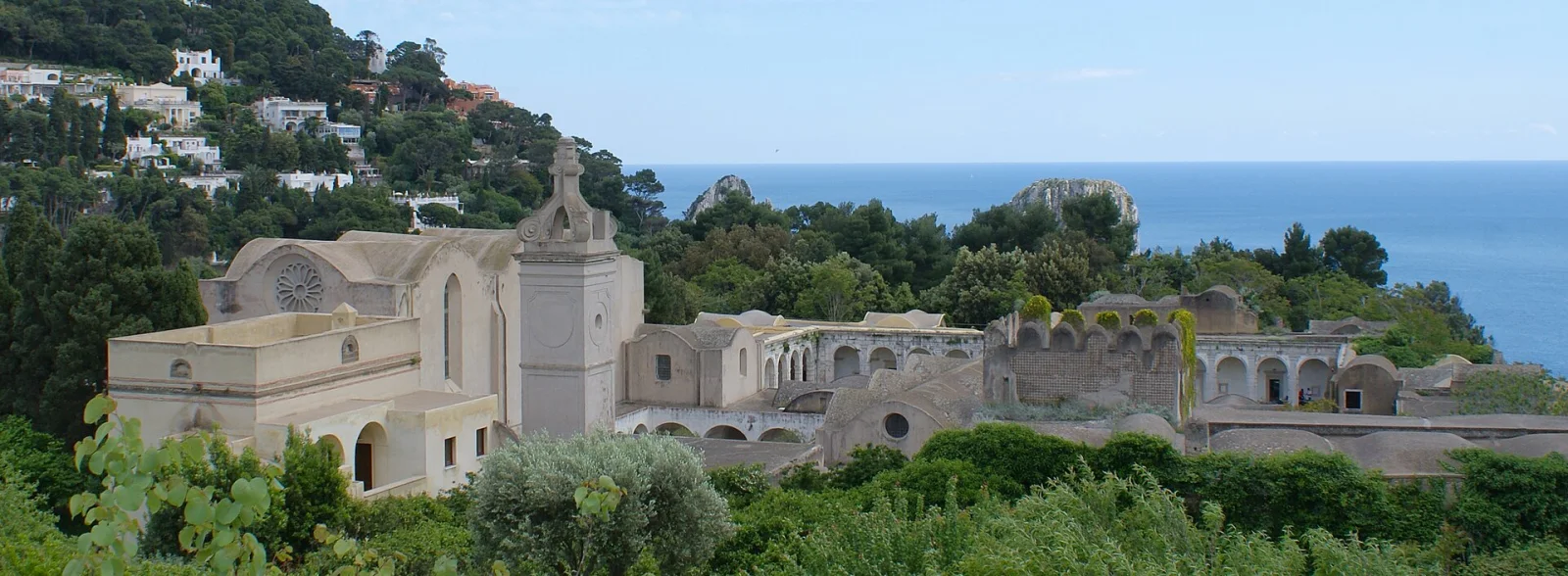
Capri is the island of the Faraglioni and the piazzetta, but its oldest building is an enclosed monastery: Count Giacomo Arcucci, secretary to Queen Joanna of Anjou, founded it in 1371 on land she had given him, and fifteen years later, having fallen from favour, he retired here as a monk. The Carthusians stayed more than four centuries, with the queen's privileges, the island's land and the grazing rights, and with the Capresi detesting them: during the plague of 1656 the monks sealed themselves in, and the islanders in retaliation threw their dead over the wall. Napoleon expelled them in 1808; then barracks, poorhouse and prison for anarchists, and finally a museum.
What to see
The two cloisters, which are the reason to come: the Small Cloister, of the fourteenth century, with Roman marble columns taken from the island's imperial villas and reused capitals, and the Great Cloister, of the sixteenth, wide and white, with the monks' cells around it and the view opening out. The church with the fourteenth-century fresco by Niccolò di Tommaso above the doorway, the pharmacy, the tower, and the gardens on the cliff edge from which you see the Faraglioni and the Marina Piccola: it is the most beautiful and quietest spot on Capri, five minutes from the piazzetta and with nobody there.
Inside, two museums. The one dedicated to Karl Wilhelm Diefenbach, the German painter who arrived on Capri with a long beard, a tunic and theories about vegetarianism and the natural life, and died here in 1913: his enormous blue symbolist canvases fill a hall and resemble nothing else. And since 2024 the National Archaeological Museum of Capri, with a hundred and twenty pieces back from the storerooms of Naples: the sculptures, frescoes and silver from the villas of Augustus and Tiberius, who governed the empire from an island here, and since 2026 the rooms on medieval Capri too, with the restored sarcophagus of Crispina.
Visiting
The charterhouse is on Viale Certosa, five minutes' walk from the piazzetta along Via Vittorio Emanuele and the Gardens of Augustus; a state museum with its own ticket, closed on Mondays, with hours that change between summer and winter. An hour and a half with the two museums, half an hour for the cloisters and gardens. In summer it is the only cool, empty place on the island at peak hours.
Our editors' tip
Go around five, when the day-trippers have gone back to the ferries: sit in the Great Cloister, where the noise does not reach, and then go out into the garden behind to look at the Faraglioni from above with nobody beside you. In the Small Cloister, look for the Roman columns: they come from Tiberius's villas, and the monks used them as bricks.