On 17 August 1826 the Prussian poet August Kopisch, the painter Ernst Fries, the Capri boatman Angelo Ferraro, the innkeeper Giuseppe Pagano and the donkey driver Michele Federico went into a cleft in the cliff that the islanders called the cursed cave and kept well away from, certain that spirits and devils lived inside. They came out with a new name for it: the Blue Grotto. Kopisch published his account of that day in 1838 in the yearbook Italia, and has passed ever since for the discoverer of a cave that was hardly unknown: the place name Gradola already appears on a chart of 1696 in Vincenzo Coronelli's Isolario.
What to see
The light that made the cave famous does not come in through the mouth but from below. A submerged window opens directly beneath the cleft and filters the sunlight: it holds back the red and lets the blue through. Because of total internal reflection, if the sea is perfectly still the threshold fails to light the cavern: a little movement of the water is needed. Objects put into the water look like silver because they gather a skin of tiny air bubbles, whose refractive index differs from that of the water and sends the light back out.
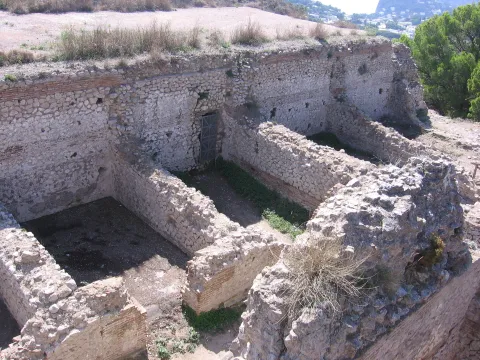
The chamber visitors see is the Duomo Azzurro, twenty-five metres wide and some sixty long, with a vault seven metres above the water that rises to fourteen at the far end; counting the submerged threshold, there are thirty-six metres from the bottom to the roof. In Roman times the cave was the sea nymphaeum of the villa of Gradola. In the south-western corner the Romans levelled a platform with crushed brick mortar, and Amedeo Maiuri was the first to work out what the place had been; the statues of Neptune and of tritons recovered from the sea floor in the 1960s, now in the Casa Rossa museum at Anacapri, proved him right. In 2009 seven more statue bases came up, so there are figures down there still. At the back of the cave three passages lead to the Sala dei Nomi, covered with the signatures of nineteenth-century visitors.
Visiting
You can only go in by rowing boat, four people at a time and lying flat on the bottom of the hull: the mouth stands little more than a metre above the water and the oarsman drops the oars to haul the boat through on a chain fixed into the rock. The grotto closes as soon as the swell gets up or the tide rises, and it is not unusual for it to stay shut for days; swimming is forbidden. There are two ways to reach it: the launches that leave from Marina Grande, or overland from Anacapri, taking the bus to the Grotta Azzurra stop and then the stairway down to the Gradola landing. Either way you pay twice, for the small boat and for admission, and the time inside lasts only a few minutes.
Our editors' tip
We take the land route and the early morning. From Gradola you step straight down to the water and get into a boat before the launches arrive from Marina Grande, which unload dozens of people at once around midday; waiting offshore, in the sun, in a boat that rolls, is the worst part of the trip. And before setting out it is worth asking at the harbour how the sea is: with a sirocco the entrance stays shut, and from Anacapri you go down for nothing.