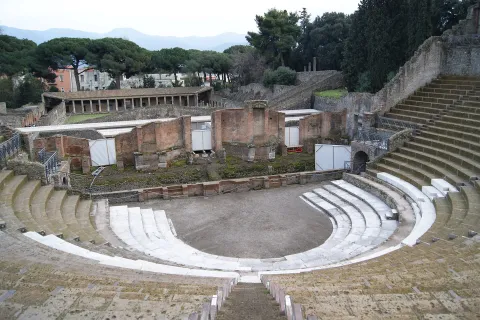
It is the oldest Roman amphitheatre still standing: built around 70 BC, when in Rome fights were still held on wooden stands, by two magistrates of the new colony who paid for it out of their own pockets to show that Pompeii had become Roman. They still called it spectacula, because the word amphitheatre did not exist. Twenty thousand seats, for a city of not many more inhabitants, and set against the walls, in the farthest corner, so that the crowds on game days would not get in the way of the rest. It was one of the first buildings excavated by the Bourbons, from 1748, and one of the few in the world where concerts are still held: Pink Floyd in 1971, without an audience, and David Gilmour in 2016, with an audience, for the first time since the year 79.
What to see
From outside, the two great double staircases climbing on the exterior up to the top level, an idea the Colosseum does not have; under the blind arches stood the vendors. Inside, the arena is dug six metres below ground and has no underground chambers, because the model was too ancient: the gladiators entered from the two corridors on the axis, one with the entrance arch and one for carrying out the wounded and the dead through the Porta Libitinensis. The cavea is divided into the three usual rings, the notables at the bottom near the arena, the people in the middle, the women at the top, and around it ran the canvas velarium, with the posts still legible on the rim.
The parapet of the arena was painted with gladiator duels, and on the outer walls were the posters of the shows, with the names of the fighters and their nicknames: one was the girls' heart-throb. In 59 AD, during the games, Pompeians and Nucerians went at each other with knives on the tiers, with deaths, and Rome closed the amphitheatre for ten years: the scene of the riot, painted in a house nearby, is today in the Archaeological Museum of Naples, with the plan of the building seen from above, and it is the first drawing of an amphitheatre in existence. Next door is the Great Palaestra, the sports ground with the pool and the portico, where the young men trained.
Visiting
The amphitheatre is in the south-eastern corner of the excavations, near the Piazza Anfiteatro entrance and the Pompei station of the Circumvesuviana, or twenty-five minutes on foot from Porta Marina along Via dell'Abbondanza; it is included in the park ticket, open with the hours of the excavations, with closures on concert days. Half an hour, with the Palaestra; entering from here, in the morning, avoids the queue at Porta Marina.
Our editors' tip
Enter by the gladiators' corridor, the long dark one, and walk to the centre of the arena without looking up: then raise your head, and the twenty thousand empty seats fall on you all at once, as they fell on the fighters. It is the effect the building was designed for, and it still works. Then climb to the top by the outer staircase, and look at Vesuvius from there.