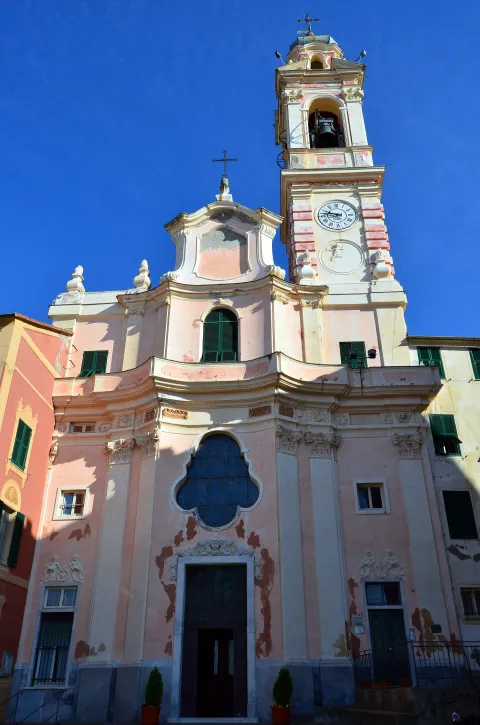
On 18 November 1744 the community of San Siro di Viganego put its complaint in writing: the people of Terrusso had run up a bell tower taller than the agreed design allowed. That episode explains this parish church of the Bisagno valley better than any description could, born as a hamlet chapel and grown until it stopped keeping to its place.
What to see
The original chapel was dedicated to Saint John the Beheaded and was probably raised shortly before or shortly after 1645; the official blessing came on 12 August 1666, from the vicar general Antonio Ratto. In 1742 the Senate of the Republic of Genoa declared it a secular chapel under its own protection, and that is where the friction with Viganego began, the parish on which Terrusso depended.
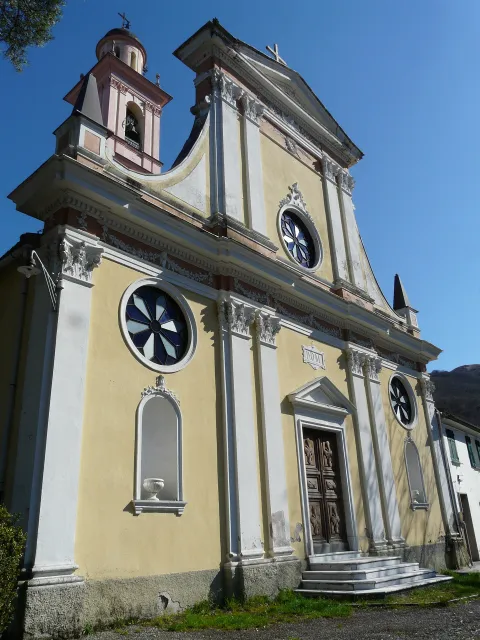
The shape you see today is that of the enlargement of 1772-1773, which also involved rebuilding the choir. The disputed bell tower was made again from scratch and raised further in 1863. On 20 December 1917 the archbishop of Genoa, Ludovico Gavotti, elevated the church to parish status; in 1928 the façade was redone, and in 1986 came the widest round of works of the twentieth century: complete repainting, roof, doors and windows, and a sacristy with a new marble floor. On the tower today there is an electronic clock with three faces on three sides.
Visiting
Terrusso is a hamlet of Bargagli and the church stands in via Pasubio, on the slope that climbs the Bisagno valley above Genoa. It is the seat of the parish of the same name in the Medio-Alto Bisagno vicariate of the archdiocese of Genoa: a village church, in service, with no custodian and no ticket, so the right hour to find it open is the hour of services. Anyone arriving at other times can still take in the façade and the tower, both of which read clearly from the road.
Our editors' tip
We stop first at the bottom of the street, where the bell tower separates itself from the houses: it is the only spot from which the eighteenth-century quarrel makes sense, because the tower is still taller than a hamlet chapel ought to allow itself. Then we go in, and it is worth looking for the choir, the part rebuilt when the chapel became a proper church.