Rebuilt between the late 10th and early 11th century by order of Adelaide of Burgundy, widow of Emperor Otto I, San Fruttuoso Abbey traces its origins to an 8th-century escape. According to tradition, Bishop Prosper of Tarragona fled the Arab invasion of the Iberian Peninsula, arriving in this isolated cove with the relics of Saint Fructuosus, a 3rd-century bishop martyred under the Roman Emperor Valerian. While early remains known as the "Chiesa Vecchia" sit halfway up the hillside, the current complex dates to the mid-9th century before passing to the Benedictine Order. The abbey's fortunes were bound to the aristocratic Genoese Doria family, who expanded it in the 13th century based on the design of Genoa's noble palaces and maintained patronage until the 1700s. Following a severe decline that saw the monastic spaces repurposed as a sheep barn, the Italian Government initiated structural repairs in 1933. A comprehensive renovation followed from 1985 to 2017 under the Fondo per l'Ambiente Italiano (FAI), thanks to the 1983 donation of the estate by Frank and Orietta Pogson Doria Pamphilj. Geographically, the religious site sits within the Portofino Natural Park in the municipality of Camogli.
What to see
The Romanesque complex features slate roofs and layered architectural modifications. The internal "monastic" church retains 10th-century plastering and flooring, distinguished by an apse carved straight into the bare rock. Its high altar holds a small silver casket containing the ashes of the martyrs Fructuosus, Augurius, and Eulogius. These were historically kept in the "sancta sanctorum", a tiny room that forms the oldest nucleus of the settlement. Above the structure sits a Byzantine-style dome decorated with seventeen local stone arches. This culminates in a 10th-century spherical and slightly oval tower—one of Liguria's oldest architectural elements—which was subsequently encased within the tall octagonal tower with pilasters visible today.
The 13th-century sea-facing wing connects to the cloisters. The lower level accommodates the Doria family crypt, housing the remains of seven members who died between 1275 and 1305. The masonry tombs display typical Ligurian alternating bands of black slate and white marble, topped by pointed arcosolia, small marble columns, gabled roofs, and epigraphs; an ancient Roman sarcophagus and two anonymous tombs share the space. The upper cloister was heavily modified in the 16th century upon the commission of prince-admiral Andrea Doria, introducing cross vaults, Romanesque capitals, and preserving a 10th-century loggia. The adjacent monastic halls now host a museum exhibiting 13th and 14th-century table ceramics used by the Benedictines, uncovered during the 1990s excavations.
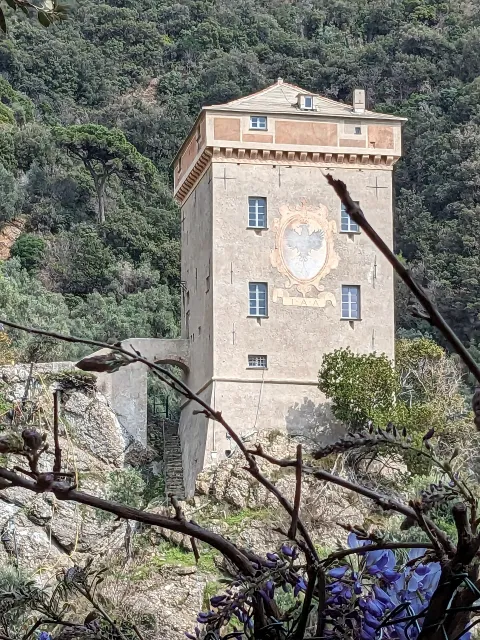
To defend the settlement and its freshwater spring from Barbary pirate raids, Giovanni, Andrea, and Pagano Doria engaged architect Giovanni Ponzello to build the Torre Doria. Completed in August 1562 for 2687 gold scudi, the watchtower displays the Doria imperial eagle crest on its facades. It was heavily armed with three bronze cannons, a bombard, and 33 muskets, eventually receiving a new roof in the 17th century from Abbot Orazio Spinola. Further west on a rocky spur stands a smaller truncated-pyramid tower erected by the Republic of Genoa in 1561, which cost 940 lire and accommodated eight soldiers equipped with two small cannons.
Visiting
With no road access available, reaching the parish seat requires arriving by sea or on foot. Visitors disembark directly onto the abbey's beach from frequent ferries departing from Camogli, Recco, Portofino, Santa Margherita Ligure, Rapallo, Chiavari, Lavagna, Sestri Levante, and Genoa. Alternatively, hikers can tackle the steep wooded trails descending through the Portofino Regional Nature Park. The routes from Portofino Vetta and Portofino Mare each take roughly ninety minutes to complete. During the opening seasons, FAI regularly schedules classical and popular music concerts within the abbey's historic walls.
Our editors' tip
Beyond the medieval architecture, the bay itself conceals a renowned submerged monument. Resting on the seabed at a depth of 17 metres (56 ft) is the Christ of the Abyss, a bronze statue placed in the water in 1954 and restored in the 1990s. If the sea is calm and clear during your ferry approach, look over the side to spot its silhouette, or book a diving excursion to view the tribute up close.