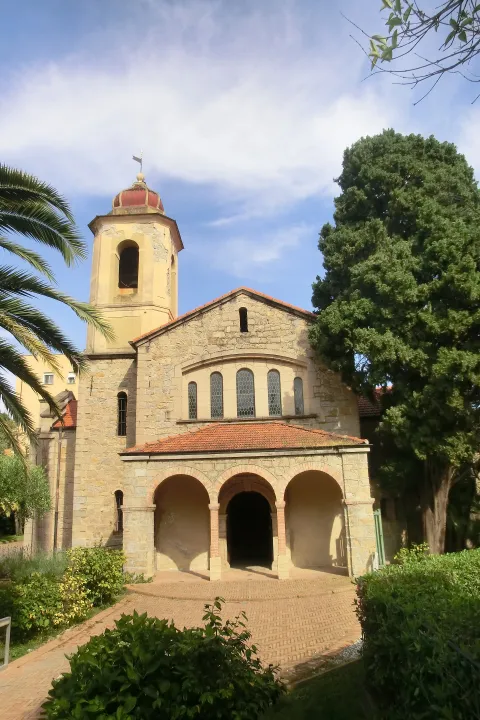
In 1866, to pay for the restoration of their parish church, the people of Bordighera brought the priest their family jewellery: rings, chains, earrings, which were melted down and turned into stucco and fine gold. The story is still told locally, and it concerns an already old building: raised in the seventeenth century in front of Piazza del Popolo, Santa Maria Maddalena was consecrated in 1617. The second restoration, between 1881 and 1883, caught the parish priest, Father Giacomo Viale, with almost empty coffers; he asked contractors, artists and men of letters for help, and a letter from the contractors Mombelli and Bulgheroni tells us that the plans of the church reached the desk of Charles Garnier, the architect of the Paris Opera, who kept a house in Bordighera. What he suggested is unknown: no document says, and to assume more than a few pieces of advice would be a stretch.
What to see
Above the doorway is a fresco of the Magdalene painted in 1742 by Giacomo Raimondo and redone in 1922 by Luigi Morgari. The front that frames it, with Rococo stucco, dates from 1906, while the stuccowork inside, dated 1670, is by Francesco Marvaldi, of the family of architects from Candeasco near Oneglia who were much in demand at the time. The chandelier hanging at the centre of the vault is a gift from Queen Margherita of Savoy.
On the high altar stands the Maddalena in Gloria, an eighteenth-century marble designed by Filippo Parodi and probably carved by his son Domenico between 1714 and 1717. The Rosary altar holds a wooden Madonna of 1702, while the second altar on the right carries the most venerated piece: the wax statue that holds the relics of Sant'Ampelio, patron of Bordighera. The bell tower is detached from the church and rises above a late-medieval loggia; its spire, clad in painted majolica tiles, is the marker you see from far off along the skyline of the old town. It began as a watchtower, when pirate boats came off the sea and people climbed up to scan the horizon; raised higher in the eighteenth century, it became the belfry it is now.
Visiting
The church faces Piazza del Popolo, inside the old town of Bordighera, the walled core set above the seafront promenade and the railway station: you reach it on foot by climbing from the shore, or by car leaving the vehicle outside the walls, because the lanes are very narrow. It is the parish church of the vicariate of Bordighera and the Nervia Valley, in the diocese of Ventimiglia-San Remo, and the building is among the properties protected by the heritage authority for Liguria. Opening hours follow the mass timetable.
Our editors' tip
We suggest looking at the church from outside first, from the spot where the loggia and the bell tower fall into the same frame: the tower built to spot pirates and the majolica spire tell you both jobs this building has done. Inside, look for the altar of Sant'Ampelio on the right: the wax statue has an effect on people, and that, rather than the high altar, is where local devotion gathers.