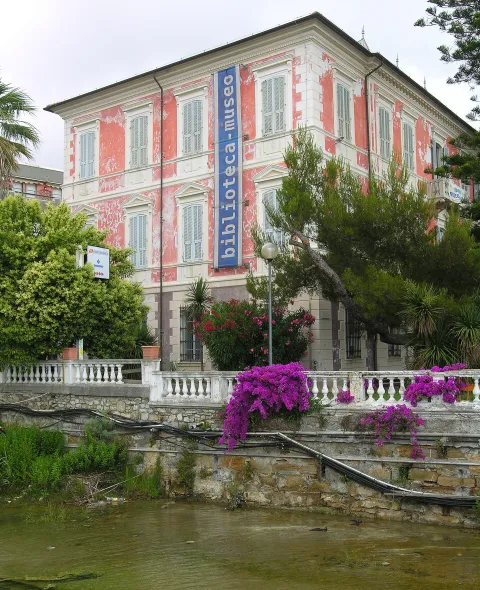
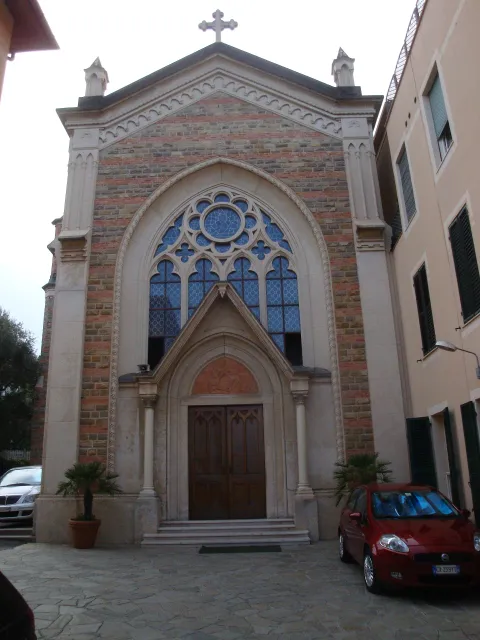
A sea battle is painted on the façade of the town hall of Diano Castello: Meloria, 1284, when the Genoese fleet destroyed the Pisan one and Genoa took the upper hand in the Mediterranean. It is not decoration chosen at random. The village sent men and a galley to that campaign, and Genoa repaid it by granting the community the title of Magnifica.
What to see
The building is 15th-century and was not born as a public seat: it was the residence of the Quaglia counts, and only later became the town hall. The fresco covers a wide stretch of the front and is the reason to stop in front of it: a 13th-century military episode kept on the façade as a statement of identity.
The rest of the village explains why that battle still counts. Diano Castello began in the 10th century as Castrum Diani, a defence against raids by Saracen pirates; it became a free municipality in 1172 and around 1228 entered Genoese territory. The statutes of the Comunitas Diani, the union of the villages of the Dianese valley, are dated 1363 and are still preserved. Near the main square lie the ruins of the castle of the Clavesana marquises, along with stretches of the walls and towers of the 11th and 12th centuries.
Visiting
This is a working town hall: the offices keep public opening hours, while the façade can be looked at from the street at any time and for nothing. Diano Castello sits on a hill above the plain between Diano Marina and Cervo; from the coast the provincial road 37 climbs up in a few minutes, and the old centre is covered on foot.
Our editors' tip
Come in September if you can: the historical procession fills the lanes with costumes, sword duels, medieval dances, a street market and medieval cooking, and the battle painted on the building goes back to being the story the village tells about itself. In other months we would pair the façade with the three churches of the centre: San Nicola di Bari, Santa Maria Assunta and San Giovanni Battista can all be seen in one morning.