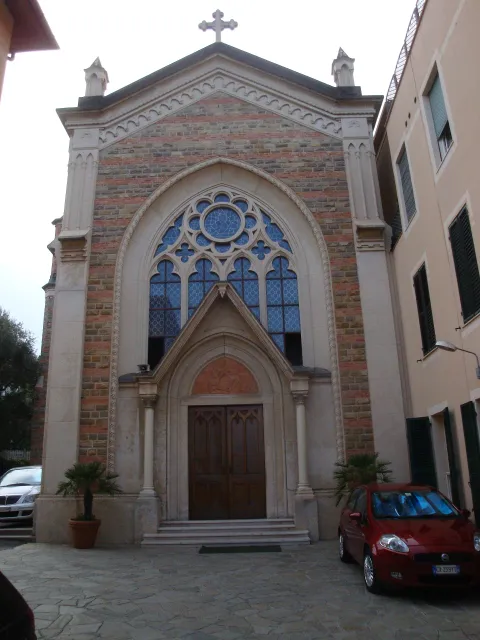
Restoration work begun in 1986 stripped the plaster from the walls of Santa Maria Assunta and brought back cycles of frescoes covering most of the interior, one of the most remarkable painted ensembles in the Imperia area and invisible for centuries. The Romanesque fabric goes back to the 12th and 13th centuries, while the bell tower beside it is Baroque.
What to see
The oldest painting is a Saint Christopher, frontal and motionless: according to Manfredini it echoes Greek icons and has close relatives in the pieve of Santa Maria della Ripa at Pieve di Teco and in the Christ Pantocrator of the parish church of Ormea. It was painted by an anonymous Ligurian-Piedmontese artist between the 14th and 15th centuries, almost a hundred years before the workshop that covered the walls with the life of Christ and the Virgin: the story opens with the sacrifice of Saint Joachim in the temple and closes with the Resurrection, Christ leaving the tomb with the crusader banner in his hand. The attribution of those frescoes to Antonio da Monteregale, long repeated, is to be rejected.
A niche in the right-hand wall holds a polyptych that follows the style and composition of the altarpiece Carlo Braccesco painted in 1478 for the sanctuary of Montegrazie: the enthroned Madonna and Child at the centre, Saint John the Baptist and Saint Clare at the sides, and in the upper register the Man of Sorrows between Saint Sebastian, a monastic saint, Saint Anne Metterza and Saint Nicholas. On the blind wall facing the presbytery two 16th-century polyptychs are displayed: a Madonna and Child from the circle of the Brea, painters active between Liguria and the county of Nice, and a Saint Lucy with saints close to the circle of Agostino Casanova. Outside, the apse keeps a continuous run of arching on figured corbels carved as heads, single-light windows, small arches with their cornice and the cross-shaped opening in the gable: Romanesque details, not Gothic ones.
Visiting
The church stands in the old centre, between via delle Torri and piazza Giudice, a short walk from the parish church of San Nicola di Bari. Diano Castello occupies a hill above the plain running down towards Diano Marina and Cervo: from the coast it is a few minutes up the provincial road 37, and the village itself is walked. No opening times are published, so if the door is shut it is worth asking at the parish.
Our editors' tip
Walk around the outside of the apse before going in: the carved faces on the corbels can only be read from there, and the low afternoon light makes them far clearer. Inside, look for the Saint Christopher first and the 15th-century cycle afterwards: almost a century separates them, and the way the painted architecture and perspective are built changes visibly to the naked eye.