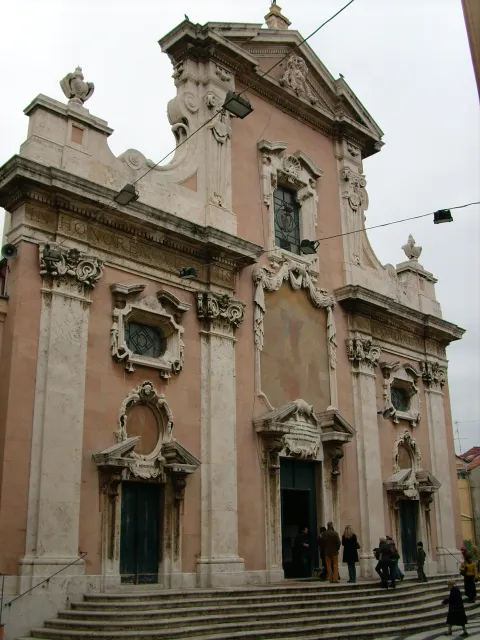
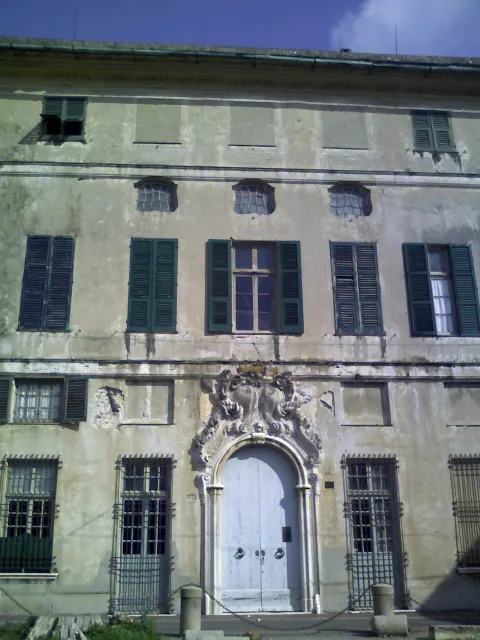
The historic villa of Albissola Marina belongs to the municipality of Novara, on the other side of the Apennines. It is not a filing error: in 1961 the last owner, Alessandro Faraggiana, son of senator Raffaele and without direct heirs, left the whole property by will to his family's Piedmontese city; since 1968 the house has been open to the public for visits and exhibitions. Before that it belonged to the Durazzo: Eugenio and his nephew Gerolamo enlarged it over decades from 1717 onwards, and the first residential block, the palazzo dell'Olmo, went up in 1735, built by a probably Genoese architect with local craftsmen. Work on the large garden began in 1738. In 1821 the villa passed to the Novara nobles Giuseppe and Gerolamo Faraggiana, who gave it the name it still carries.
What to see
The set piece is the Gallery of the Seasons, built in 1750 for Marcellino Durazzo: a row of arches opening onto the garden, designed for the family's parties. Frescoes with episodes from the life of Diana run across the vaults; the floor is polychrome maiolica tiling; along the gallery stand the carved sculptures by Filippo Parodi, dated 1667, the Mirror of Narcissus and the Four Seasons, that is Flora, Ceres, Bacchus and Saturn. According to some studies those four figures were originally meant to be nothing more than candelabra.
In the eastern wing is the chapel of the Misericordia, the family's private chapel but once used by the people of the neighbouring houses too: on the altar is the Apparition of the Virgin by Giovanni Agostino Ratti, and around it survive candelabra, embroidered vestments and gold work. The original pastel tones have gone under a nineteenth-century repainting that part of the critical literature considers too heavy. The gilded room was ordered by Giuseppe Faraggiana in 1845 and furnished by Enrico Tomaso Peters, the same cabinetmaker then at work in the Royal Palace of Genoa for Charles Albert of Savoy: gilded furniture, neoclassical taste, clashing with the eighteenth-century study and the Pregadio with their maiolica floor. Outside, the garden combines an Italian formal layout, French vistas and the terracing imposed by the Ligurian slope; the Faraggiana, less interested than the Durazzo in display, turned it almost into a family farm, with cereals, wine and olive oil to sell.
Visiting
The villa is on via Salomoni, minutes from the seafront of Albissola Marina, and is open as an exhibition venue: hours change with the season and with the exhibition calendar, so it is worth checking before you set out. The route inside is short, but the rooms are furnished rather than bare: allow a good hour if you want to look at the furniture and not only at the vaults. Wear comfortable shoes for the garden, which is terraced.
Our editors' tip
Look at the floors. In a town of potters like Albisola, maiolica tiles are not decorative detail but the local signature, and in the Gallery of the Seasons they hold their own against the frescoes overhead. We keep the garden for last and step into it through the arches of the gallery: that is the point from which the Durazzo meant it to be seen, and only from there does the difference show between their display garden and the fields the Faraggiana planted.