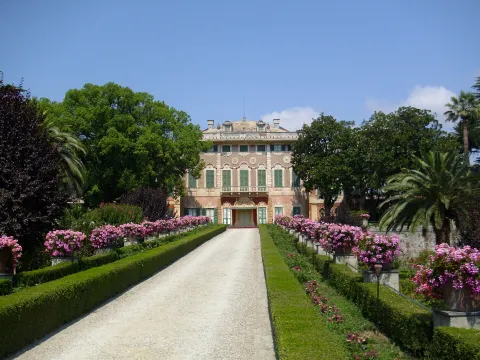
On 29 January 1765 Francesco Maria della Rovere was elected doge of the Republic of Genoa, and at once ordered a complete overhaul of the family house at Albisola Superiore: 100,000 zecchini spent on a building he had inherited in 1744 from his father Clemente. People called it Cà Grande, and local tradition makes it the birthplace of Pope Julius II. Shortly after the doge died the villa passed to Luigi Gavotti, a kinsman of the Della Rovere; his is the name it still carries, and his family still owns it.
What to see
The layout is standard Ligurian: a squared block of three floors, the chapel on the north side, and to the south two low terraced wings, mirror images of each other, converging in a pair of curving staircases. Between them lies the formal Italian garden with four fountains; beyond it the grove of cypresses, holm oaks and cedars of Lebanon, with the sculpture group of Hercules wrestling the Nemean lion. The balustrades are Carrara marble, topped with urns and statues by Tuscan sculptors.
Under the northern terrace open the three rooms of the seasons, modelled in 1760 by the Porta brothers from Milan: in Spring flowering plants rise out of the capitals as if out of vases and tangle towards the ceiling, in Summer putti reap wheat beneath branches heavy with fruit, in Autumn vine shoots twist around the windows. The fourth room imitates a cave, lined with shells, stalactites taken from the nearby Bergeggi grotto, and coral: Napoleon's troops carried off the original coral, which was remade in stucco. The chapel keeps the organ built by Tommaso II Roccatagliata in 1762 and a Saint Catherine by Francesco Schiaffino. On the main floor Andrea Levantino painted scenes of country life on walls, doors, vases and ceramic tiles; the furniture did not come from Paris, as fashion demanded, but from cabinetmakers in Albisola and Genoa.
Visiting
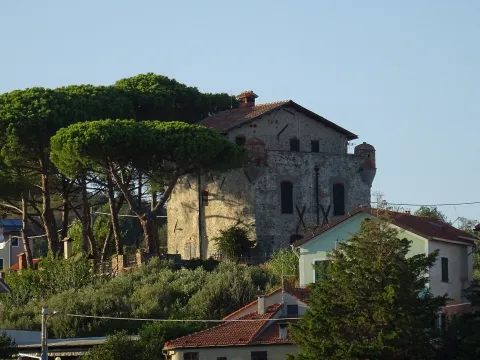
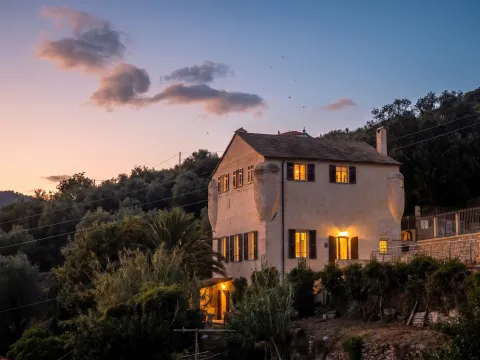
The villa stands on via Francesco Maria della Rovere, on the plain behind the town centre. It is not a museum with fixed hours: the property is private and openings are occasional, tied to events and guided tours, so ask the town council of Albisola Superiore before you go. Even from outside there is plenty to read, starting with the orange-yellow of the walls, the same colour once used on the farmhouses scattered across the plain and belonging to the estate.
Our editors' tip
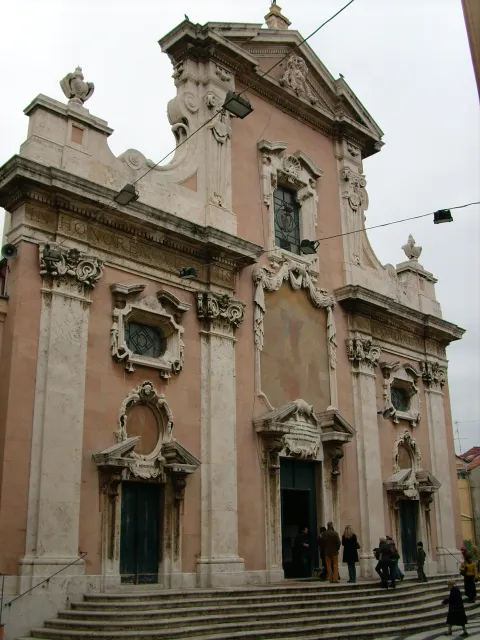
Find the spot where you can see the villa and the baroque outline of the church of San Nicolò at the same time: that was where the landscape designed by the Della Rovere ended and the hills began. Post-war building has filled almost all the ground between them, but the line linking the two is still traceable, and it is the quickest way to grasp what this house actually was: not an isolated residence, but the hub of a reorganised countryside.