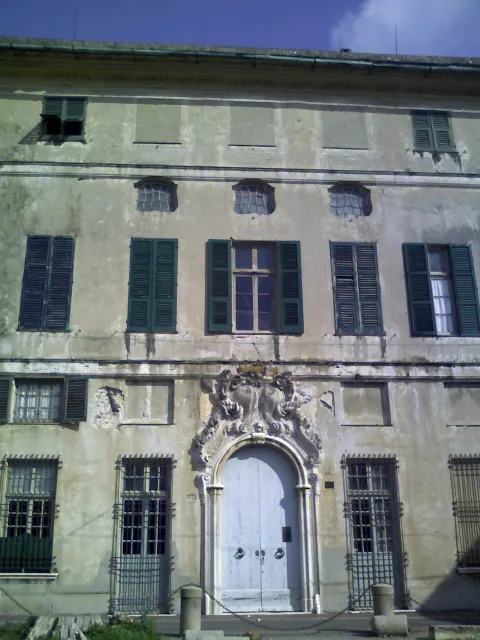
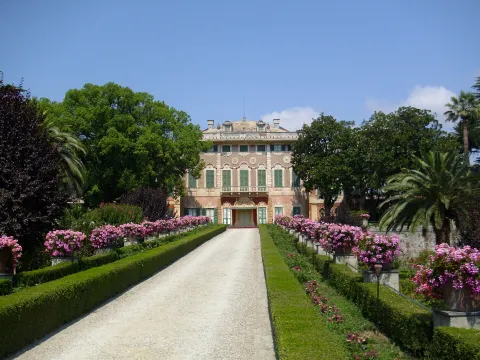
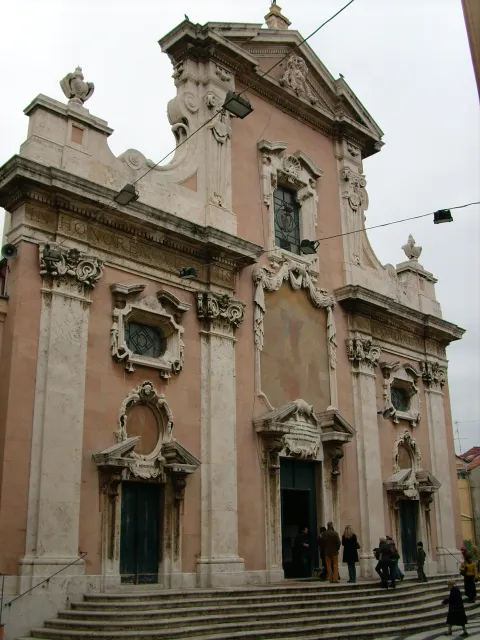
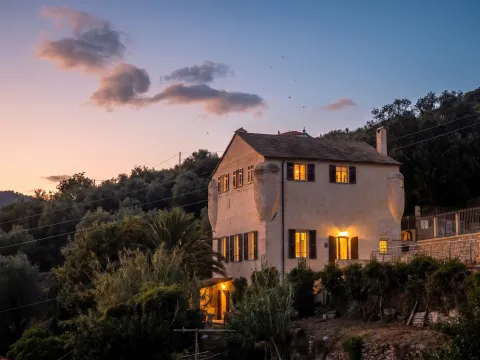
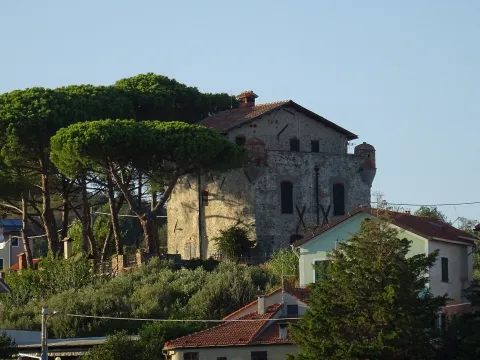
Manlio Trucco was the first to bring third-firing metallic lustre into the ceramic workshops of Albisola, a technique that many other artists would go on to study, Lucio Fontana among them. The museum that carries his name occupies the house he had built for himself in 1936 on the via Aurelia, at Albisola Capo, designed by the engineer Fabris and the architect Mario Labò: two floors that housed his firm, Trucco Ceramiche d'Arte. He gave the building to the town on one condition, that it become a museum at the disposal of Ligurian artists. It opened on 21 May 1989.
What to see
The rooms gather Ligurian ceramics from the fifteenth century onwards. To that core is added a collection of maiolica on loan from the San Martino hospital in Genoa: largely apothecary jars and containers from the Savona workshops of the seventeenth and eighteenth centuries, in the blue-on-white of the antico Savona manner. In the garden, the Battaglia by Agenore Fabbri is on permanent display, and since 2009 the building has also housed the town library.
The rest tells Trucco's own story. Born in Genoa in 1884, raised in Belém, in Brazil, where his father ran a rubber company; then Mexico, where he studied pre-Columbian Aztec and Maya ceramics, and in 1911 New York and Paris, where he drew patterns for silks at Paul Poiret's Martine atelier and moved among Modigliani, Severini, Matisse and Max Jacob. He brought art deco home with him, and in his hands it mixed with the traditional Savona palette. In 1922 he opened the La Fenice works with Cornelio Geranzani, where Arturo Martini also worked.
Visiting
The entrance is on the via Aurelia, at Albisola Capo. The building has two floors and shares them with the town library, so the hours are those of a municipal service and change with the season: check them before turning up. Counting the garden, an hour and a half is enough for a proper visit, and anyone with an interest in ceramics will happily stay longer.
Our editors' tip
We suggest starting with the apothecary jars from the San Martino rather than with Trucco's own work: when you then reach his pieces, you see at once how much he kept of the local tradition and how much he carried back from Paris. And before you leave, the garden: the Battaglia by Fabbri is out there, not in the rooms, and it is easily missed.