For a hundred and twenty years, from 1860 to 1980, a single family in a house-workshop at Bardino Nuovo built tower clocks by hand. The Bergallos sent them to bell towers and civic towers across Italy and abroad, and a good number still strike the hours. The last master, Giovanni Battista Bergallo, died in 1996 at ninety-two, with no heir to carry on the trade; years earlier he had asked publicly that the tools, machines and papers should not be scattered. The museum grew out of that request: founded in the year of his death, it opened on 7 April 1997, the first of its kind in Italy.
What to see
Fifty tower clocks from the Bergallo workshop are on show, in eleven rooms over two floors of the former town hall, across more than 260 square metres. Beside the complete machines lie the loose parts, which explain the craft better than any label: wheels, pinions, pivots, side frames, hands, pulleys, dial numerals and weights, some of them from the seventeenth century, given to the museum by private owners, collectors and parishes.
The least showy section is probably the most instructive: working notes, accounts and estimates, the bookkeeping of a workshop that lasted a century, with prices and clients in plain sight. A room on the ground floor presents a portion of the original place of production. Since 2013 the visit also takes in twenty-five paintings on the theme of time, by Luciano Laschi, donated by the artist to the town.
Visiting
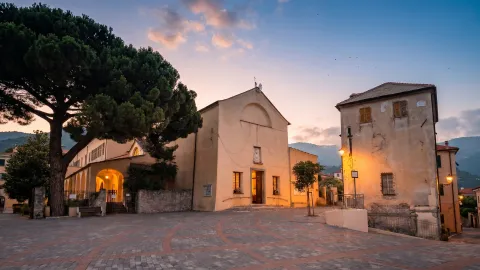
The museum is in piazza Canonico Folco at Bardino Nuovo, next to the parish church of San Sebastiano, on the road that climbs from Pietra Ligure towards Magliolo. The former town hall was enlarged from 2002 and re-laid out through 2011, and that is the arrangement you walk through today. In the little square in front stands the workshop where clocks and mechanisms donated to the town are repaired and kept. A short way up, in via San Sebastiano, the Bergallo house-workshop is still recognisable; everything came out of that building. The museum belongs to Museimpresa, the Italian association of company museums; check the website for opening times before setting off.
Our editors' tip
Ask about the clock that went to Patagonia: in 2017, for the museum's twentieth anniversary, the town commissioned Alessandro Beltrame to make a documentary about the sale of a Bergallo machine to the Salesian mission at Puerto Santa Cruz, in Argentina. No other story gives a better sense of how far the output of a handful of people travelled. And if you come with someone who loves opera, remember that Renata Scotto was evacuated to Tovo San Giacomo as a child during the war and said she decided there that she would sing; that summer she was given the freedom of the town, in the museum itself.