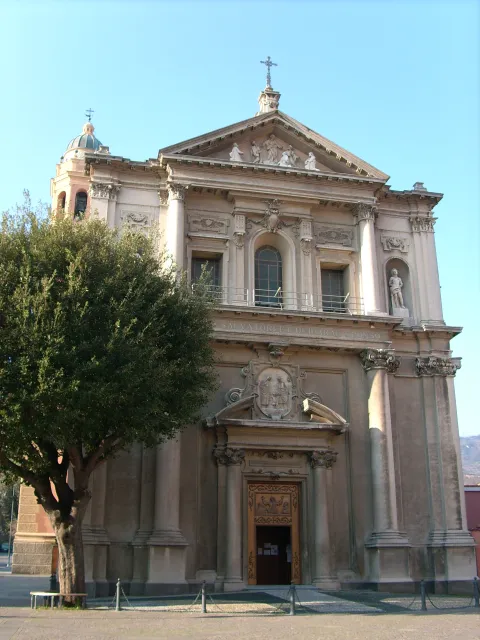
Beside the font, in the first chapel on the left, stands a Baptism of Christ by Anton Maria Maragliano: the greatest Ligurian woodcarver of the eighteenth century, in a provincial parish church. San Giovanni Battista was built in the eighteenth century and faces the square that carries its name, in the centre of Vado Ligure; it is the seat of the parish of the same name, in the Vado Ligure vicariate of the diocese of Savona-Noli. Inside, a single nave and, along the walls, a collection of paintings and sculpture assembled over three centuries.
What to see
Start with the counter-façade, where a Crucifixion dates from the building years themselves. The first chapel on the right holds the Death of Saint Joseph, a Genoese-school canvas of the eighteenth century; on the altar of the right transept is a large statue of the Sacred Heart by the sculptor Luigi Venzano, in plaster patinated to imitate bronze — a device Ligurian workshops used often in the twentieth century, and one you can still spot here at close range.
The presbytery gathers two paintings by Francesco Baracca, the Raising of Lazarus and Tobias burying the dead during the Babylonian captivity. At the end of the choir, Giannetto Fieschi's canvas of 1965 shows Christ on the banks of the Jordan with John the Baptist and the future disciples Andrew and John: contemporary painting slotted without hesitation into an eighteenth-century container. On the left transept altar stands the Presentation in the Temple by Domenico Bocciardo, dated 1720; next to the Maragliano, an altarpiece of the Visitation with saints Peter and Andrew, by a Ligurian painter whose name is lost.
Visiting
The church is in piazza San Giovanni Battista, in the old core of Vado Ligure, on the via Aurelia just west of Savona: you can walk there from anywhere in town. It is a working parish rather than a museum, and opening follows the liturgy — the half hour before or after mass is the safest moment to find the doors open. There are no marked routes and no long labels inside, so it pays to arrive knowing what to look for; the single nave helps, since a few steps take you between both transepts.
Our editors' tip
We suggest a comparison: first Maragliano's carved Baptism of Christ by the font, then the Fieschi canvas at the end of the choir. The same subject — the Baptist and the Jordan — two and a half centuries apart, a baroque wood group and a twentieth-century painting under one roof. Then go back to the Venzano statue and look closely: the bronze patina over plaster is the kind of trick you only catch with your nose against it, and it is worth the stop.