One corner of the bell tower rests on a Roman column, the only survivor of those that must have carried the vaults of the Romanesque church: no other detail sums up San Pietro in Carpignano better. The spired brick tower dates from the fourteenth century and was itself put up with reused classical material. The church first appears in the records on 24 April 1180, when Peter, provost of San Giorgio, granted Ottone di Traisio the rights over it for twenty-nine years, an act that reveals its dependence on the Benedictines of Fruttuaria; in 1191 the marquis Ottone Del Carretto sold the consuls of Savona everything he owned from San Pietro as far as Savona, and the church served as the boundary marker between Savona and Quiliano.
What to see
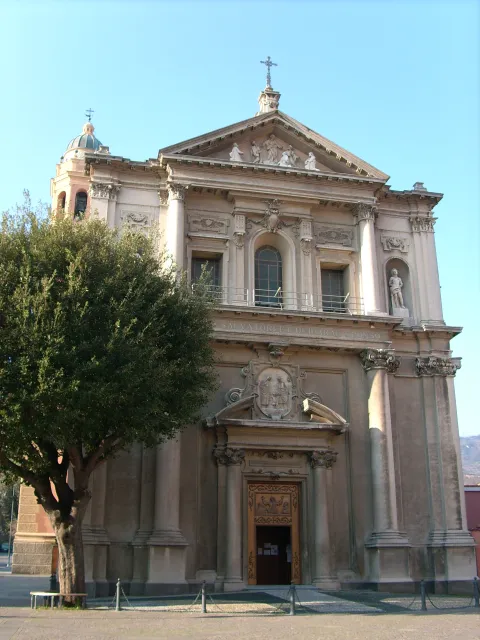
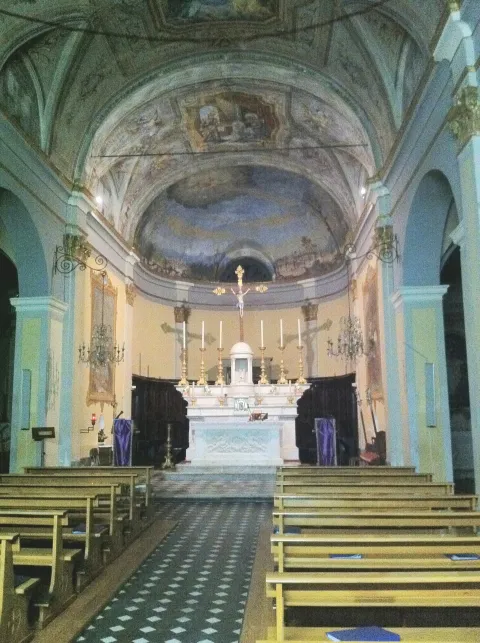
The building you see today is the result of remodelling between the seventeenth and eighteenth centuries. Around the middle of the seventeenth century the Romanesque church, oriented east like the oldest ones, was shortened to roughly half its length and turned: the entrance shifted by 90 degrees, the semicircular apse ended up facing south, and the churchyard was laid out in front. The present body, a single nave with an arched portal, dates from 1710, when the chapel was restored at the wish of Annamaria Gavotti, absorbing the first section of the earlier church. On the right flank the base of the Romanesque apse survives, along with stretches of walling that link the front to the bell tower, which stands apart from the hall and is joined to it by a room with an arched opening.
The rest of the story is in the ground. Excavations have produced material from the first century onwards, stretches of the extensive water channelling of the Fundus Carpinianus, fragments of wall painting and mosaic, Roman and early medieval inscriptions, pottery and metalwork; the burial ground beneath the church was in use from the imperial age until the eighteenth century, and it is precisely the sequence of funerary rites that archaeologists have been able to reconstruct best. A Roman tank suggests a farming settlement facing a branch of the via Aemilia Scauri, which linked Vada Sabatia — today's Vado Ligure — to the Po plain through the Val Quazzola, where Roman bridges still stand. Pilgrim badges have turned up among the finds as well.
Visiting
The church stands at the centre of the archaeological and nature park of the same name, established by the Liguria Region in 2010, on a shelf raised just above the Quiliano stream: a position chosen to stay clear of its floods. You reach it from Quiliano, in the hinterland between Savona and Vado Ligure. The interior can be seen during the periodic guided visits, with free admission at every time of year; outside, the bell tower and the fragments of walling read clearly if you walk around the apse.
Our editors' tip
We suggest looking for the column at the foot of the bell tower first and then following it upwards with your eyes: it is the quickest way to grasp how much Roman material ended up inside this church. Keep the local name in mind too, San Pè d'i Coi, 'Saint Peter of the Cabbages', after the crops that dominated the area until the last century: it tells you more than most plaques. And if you can, wait for a guided visit: the graves and the excavation levels stay illegible without someone to explain them.