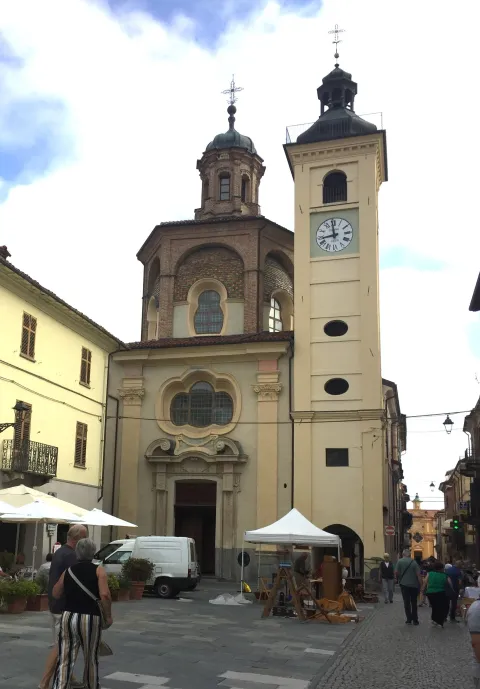
The front of this church was never finished, and it is the finest thing about it. It is of brick laid in alternating courses, projecting and receding, meant as a key for a facing that never came: the result is a wall that catches the light and gives it back in stripes, different at every hour of the day.
What to see
The architect is Bernardo Antonio Vittone, a pupil of Juvarra, who closed the works in 1749 on the commission of a local count. The front plays on a concave and convex movement that comes straight from Borromini and Guarino Guarini, the two masters Vittone had studied in Rome; on the wooden portal three arrows are carved.
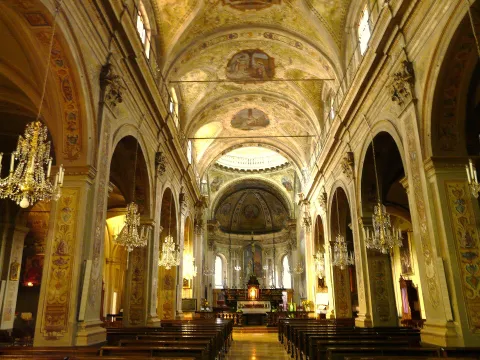
Inside, the plan is elliptical, with corinthian columns holding an oval dome with a lantern. The dome frescoes are by Michele Antonio Milocco and continue without a break into the lantern, so that the eye cannot find the point where the painting ends and the structure begins. Behind the presbytery is the oak-panelled choir, once reserved for the nuns, with a vault painted as false architecture.
Visiting
The church is in via Vittorio Emanuele, the main street of Alba; free entry with hours tied to services and openings. Half an hour.
Our editors' tip
Before going in, stop at the portal and look at the three arrows. They are the emblem of the blessed Margherita of Savoy, who had a chapel built here in 1442 after becoming a Dominican as a widow; tradition says they stand for three trials she asked to bear. Few churches introduce themselves with so unreassuring a sign.